

KEY TAKEAWAYS
- Most failed routines fail for one of four reasons: too many products at once, wrong application order, conflicting actives, or not enough time. None of these are bad luck
- A hard reset (stripping back to three products for two weeks) works better than gradual elimination because it removes all variables at once
- The three reset products are a gentle cleanser, a barrier moisturiser with ceramides, and SPF. Nothing else for two weeks
- Reintroduce one product every two weeks after the reset. Not one per week. Not two at once
- The correct reintroduction order is: hyaluronic acid first, then niacinamide, then AHAs/BHAs, then retinol last
- Your skin might look slightly worse in the first few days of the reset. That’s normal and temporary
- Lifestyle factors — poor sleep, high stress, hormonal shifts — can override even a well-constructed routine
- Conditions like rosacea, perioral dermatitis, and fungal acne look like routine failure but need a dermatologist, not better products
- If you’ve been through eight to twelve weeks of a careful, stripped-back routine with no improvement, it’s time to see a dermatologist
How to build skincare routine when nothing works?
Strip back to three products only: a pH-balanced gentle cleanser, a barrier moisturiser with ceramides, and SPF 30 or above. Use only these for two weeks. This is the skin reset — a baseline-clearing period that removes all variables at once. After two weeks, reintroduce one product every two weeks and observe carefully before adding anything else. Most skincare routines fail because of too many products introduced too quickly, wrong layering order, conflicting active ingredients, or not waiting long enough to see results. The reset removes all four problems at once and gives you a clean starting point.
You’ve done the research. You bought the products. You stuck to the routine for weeks, maybe longer. And your skin still isn’t doing what you hoped.
Most guides assume you’re starting fresh. They give you a new multi-step routine or another product recommendation, as if the problem was that you just hadn’t found the right thing yet. But if you’ve already worked through two or three routines in the past year, a fourth product list isn’t what you need.
This guide is for people dealing with a skincare routine when nothing works — not first-time beginners. We’ll go through exactly why past routines fail, how to do a proper skin reset, how to reintroduce products correctly, how to identify the actual problem product, and when the issue has nothing to do with products at all.
Why Previous Routines Fail (It’s Almost Never Bad Luck)
Bad luck plays almost no role in skincare failure. The actual reasons are far more predictable, and once you see them, they tend to feel obvious in hindsight.
The Four Most Common Reasons Routines Don’t Work
Too many products introduced too fast is probably the most common cause. When you add three or four new things to your routine within the same week, there’s no way to know what’s helping, what’s hurting, and what’s doing nothing. Your skin reacts to something. You can’t figure out what. You end up labelling the whole routine a failure when it might have been one product, maybe even just one ingredient, causing all of it.
Wrong application order is the second issue. Layering an occlusive moisturiser before a water-based serum blocks the serum from penetrating properly. The active ingredient you’re relying on never reaches your skin. You use it for weeks and wonder why it’s not working. It wasn’t working because it was never absorbing.
Not giving it enough time is the third. Your skin goes through a full renewal cycle roughly every 28 days. Most active ingredients need two to three complete cycles to produce visible results at the surface. That’s a minimum of eight to twelve weeks.
The full breakdown of how long each skincare ingredient actually takes to work covers exactly what to expect at each stage. Most people stop around week three — the worst possible moment to quit, right before the results would start.
Conflicting active ingredients come in fourth. High-percentage AHAs layered with retinoids, or vitamin C used at the same time as a low-pH acid toner, can cause barrier disruption and inflammation. Not because those ingredients are bad, but because they fight against your skin rather than working with it.
The “More Is More” Trap the Beauty Industry Profits From
There’s a financial reason most skincare content recommends adding rather than removing. Affiliate links earn commissions. Sponsored posts promote new launches. The more you buy, the more the industry earns. That incentive structure makes it genuinely difficult to find advice that tells you to strip things back.
Research on simplified routines confirms this in a review published in Experimental Dermatology, Proksch et al. (2008) that a disrupted skin barrier, a state that over-layering directly causes, is the underlying driver of most inflammatory skin reactions. Removing potential irritants, not adding new ones, was what allowed the barrier to repair.
The real reset isn’t a new product. It’s fewer products.
What I Tried That Failed (And Why It Makes Sense Now)
I want to be specific here, because vague personal stories don’t actually help anyone.
My worst routine phase involved six products: a foaming cleanser with fragrance, a toning essence, a niacinamide serum, a vitamin C serum, a retinol, and a thick moisturiser, all added within three weeks of each other. My skin got worse by week two. Dry in some patches, congested in others, and showing small bumps across my forehead that I’d never had before. I assumed every product was the problem and cleared out most of them.
What had actually happened was simpler. The foaming cleanser was stripping my skin barrier every morning and night. Everything I applied afterward was absorbing into damaged, irritated skin and behaving differently than it would on a healthy barrier. One product caused most of it. But because I’d changed everything at once, it took months to identify which one. That experience is where the reset protocol came from.
The DermaDraft 2-Week Skin Reset Protocol
If you’ve been trying to find a skincare routine that works for months with no progress, a hard reset is the clearest starting point. It’s not the most exciting answer. It is the most effective one.
Why a Hard Reset Works Better Than Gradual Elimination
Gradual elimination sounds logical, but when multiple products are irritating or conflicting simultaneously, removing one at a time still leaves the others active. You might remove the wrong one first and spend two months making no progress. A hard reset removes all variables at once, giving your skin a clean baseline influenced by nothing except three simple products. From there, you add one thing back at a time and know exactly what each addition does.
The Three Products You Keep for the Reset
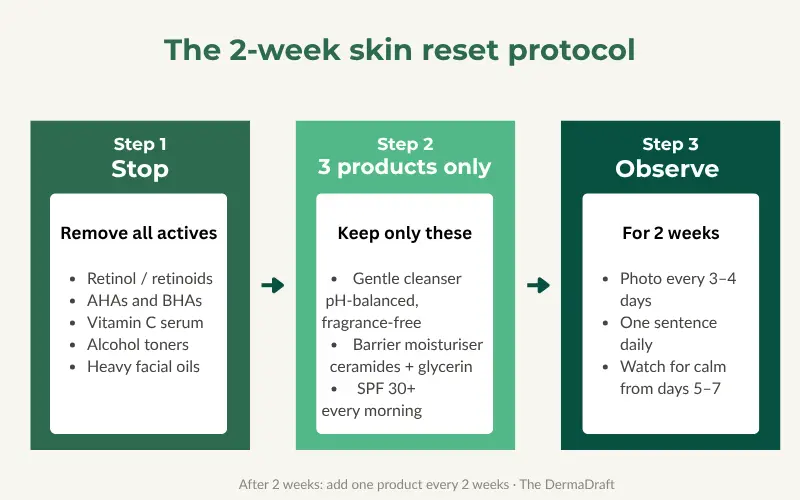
For two weeks, your routine is three products only.
A pH-balanced, gentle cleanser. Fragrance-free, sulphate-free, minimal ingredients. If your cleanser is currently causing redness or tightness after rinsing, that reaction alone tells you something important. The article on what’s really causing that redness after cleansing explains exactly what to look for in a cleanser that isn’t disrupting your barrier.
A barrier moisturiser with ceramides, fatty acids, and glycerin. No actives, no brightening agents, no retinol, no exfoliant. CeraVe, La Roche-Posay Cicaplast, and Vanicream are reliable options across different budgets and availability.
SPF 30 or above, every morning. Non-negotiable regardless of weather or season. If your previous SPF felt heavy or left a cast, this is a good time to find one that doesn’t.
That’s the whole routine. Nothing else for two weeks.
If you want the full reasoning behind why these three specific products form the right foundation, the guide to the only minimal skincare routine beginners actually need explains each one in detail
| Remove for the Reset | Keep for the Reset | Why It Matters |
| Retinol / retinoids | pH-balanced gentle cleanser | Actives need to pause so you get a clear baseline |
| AHAs and BHAs (acids) | Barrier moisturiser with ceramides | Exfoliants strip natural barrier protection during reset |
| Vitamin C serum | SPF 30 or above (morning only) | Antioxidant actives can cause sensitivity on a compromised barrier |
| Alcohol-based toners | Disrupts skin pH during the reset window | |
| Heavy facial oils | Can trap lingering irritants against the skin | |
| Sheet masks / wash-off masks | Even “calming” masks often contain actives |
What Your Skin Will Do During the Reset (And Why That’s Normal)
In the first few days, your skin may look slightly worse. If you were using retinol or acids before the reset, expect some dryness or temporary texture changes as accelerated cell turnover slows to its natural rate. This is your skin adjusting, not reacting to the reset products.
By day five to seven, most people notice their skin feels noticeably calmer. Less reactive, less tight, less inconsistent throughout the day. By the end of week two, you have a true baseline, what your skin actually looks like with nothing influencing it except three basics. That’s your starting point for everything that comes next.
If your skin is still significantly irritated at the end of week two on only three simple products, the problem may not be your routine at all. That’s covered in the final section of this guide.
How to Reintroduce Products After the Reset
The reset gave you a clean baseline. Now comes the part where most people rush and undo all of it.
Before adding new actives to your reset routine, it’s worth checking whether the ingredients you’re considering have cheaper Eastern originals, which is covered in full in how western brands repackage Asian skincare ingredients at a premium.
One New Product Every Two Weeks
One new product every two weeks is the rule. Not one per week, not two at the same time. One product. Two weeks minimum before adding anything else.
This interval exists because skin reactions don’t always appear in the first 48 hours. Some delayed reactions take five to seven days. Contact sensitisation can take even longer. A two-week window catches both immediate and delayed reactions before anything else goes in. Shortening this window is the most common mistake in the reintroduction phase, and it brings you right back to the original problem.
The 10-Day Observation Window
Within each two-week window, actively observe for the first ten days. Signs a product is working include stable skin with no new congestion or irritation. Signs to stop: redness that wasn’t there before the addition, new congestion in areas that were clear during the reset, or persistent tightness that wasn’t present with just the three basics.
If you’re not sure whether what you’re seeing is a normal adjustment period or a bad reaction, the guide on skin purging vs breakout covers the specific signs that tell them apart.
How to Document What You’re Noticing
Take a photo in the same natural light, from the same angle, once every three to four days. Write one sentence about how your skin felt that day. That’s all.
Photos catch gradual changes that daily mirror checks miss because the changes accumulate too slowly to see in real time. Notes capture how your skin feels, which photographs don’t show. The guide on what 30 days of consistent skincare actually looks like explains exactly what systematic observation looks like in practice.
Which Product to Add Back First (It’s Not a Serum)
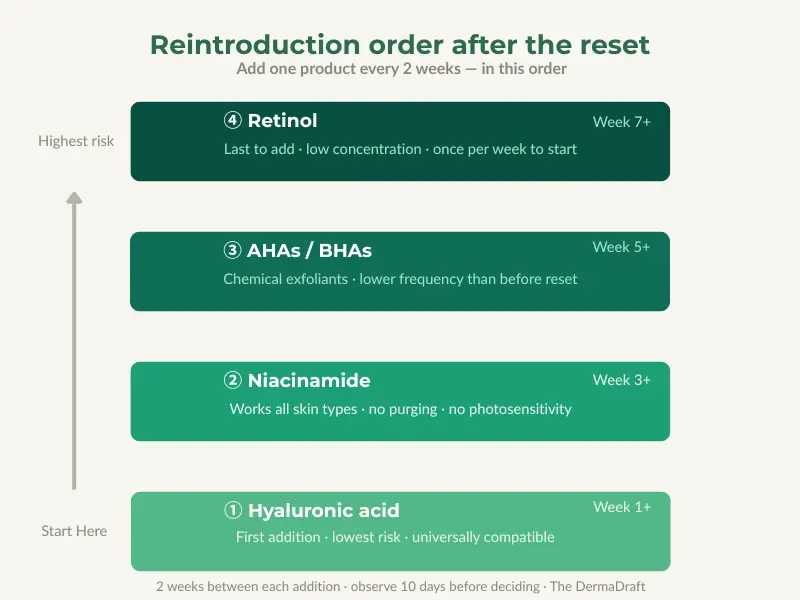
Add hyaluronic acid back first. It’s the lowest-risk addition and the most universally compatible with a freshly reset barrier. After that, niacinamide — no photosensitivity risk, no purging period, no adjustment phase. Then chemical exfoliants at lower frequency than before. Retinol comes last, at a lower concentration than before the reset. Once per week to start, then build up gradually.
The slowest way to find out what works is to skip any of these steps. Two weeks per product feels careful. It’s actually faster than cycling through another six months of combined failures.
If you’re not sure what each active does before adding them back, the breakdown of what niacinamide, hyaluronic acid, and retinol actually do in your skin covers each one with realistic result timelines.
How to Know Which Product Is Causing a Problem
Sometimes the reset and careful reintroduction still leaves you with one stubborn unknown. A product seemed fine for the first week and caused something in week two. Or two products both seem fine separately, but something still isn’t right when the routine runs together.
The Isolation Test
The isolation test is straightforward. Stop using one suspected product for a full two weeks while keeping everything else exactly the same. If your skin improves, that product is the most likely cause. If nothing changes, it probably wasn’t the issue, reintroduce it and remove something else for the next window. This only works with one variable at a time.

Why Changing Multiple Things at Once Makes This Impossible
Every time you change two things simultaneously, you lose the ability to know which one caused the change. If you swap your cleanser and add a new serum on the same day, and your skin improves two weeks later, you have no way to know which one fixed it. If your skin gets worse, you face the same problem in reverse.
One change per two-week window sounds slow. In practice, it’s considerably faster than repeating the same cycle of combined changes and unclear outcomes for six more months.
When You Genuinely Can’t Figure It Out
If you’ve done three or four two-week windows and still can’t isolate the culprit, check these before anything else.
Your pillowcase. Wash it every two to three days during testing. Cotton pillowcases trap sebum, hair product residue, and bacteria. Consistent cheek or jaw breakouts that don’t respond to products are often a pillowcase problem.
Your hair products. Leave-in conditioners, oils, and styling products that contact the hairline and temples are a common trigger for bumps in those areas, including types that aren’t actually acne, which the guide on rough bumpy skin that isn’t acne covers in detail.
Your application order. Check whether your sequence matches correct layering logic. The guide on why morning and night skincare work differently covers which products belong in which slot and why the order matters for absorption.
When the Problem Isn’t Your Products At All
There’s a version of trying everything for skin with nothing helping that products genuinely cannot fix. If you’ve reset, reintroduced carefully, and your skin is still struggling after six to eight weeks, it’s worth looking well beyond your routine.
The Lifestyle Factors Most Guides Skip
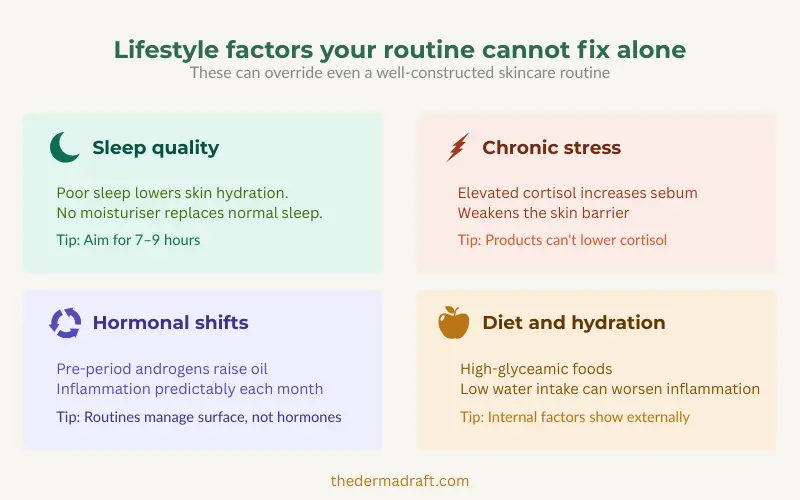
Chronic high stress increases cortisol production, which raises sebum output, weakens the skin barrier, and worsens inflammatory skin conditions including acne. You can follow the most appropriate routine correctly and still break out consistently if the underlying driver is cortisol.
Sleep quality has a direct, measurable effect on skin barrier function. A study by Oyetakin-White et al. (2015), published in Clinical and Experimental Dermatology, found that poor sleepers had significantly higher transepidermal water loss and that good sleepers showed 30% greater barrier recovery after disruption. No topical moisturiser replaces what normal sleep contributes to barrier function.
Hormonal fluctuations, particularly in the week before a period, raise androgen levels and increase oil production and inflammation. If your skin follows a predictable monthly breakout cycle regardless of your routine, that pattern points to a hormonal driver that skincare alone cannot regulate.
All of these hidden triggers are covered in detail in the guide on why you’re still breaking out even with a consistent routine, which is worth reading alongside this article.
The Physical Triggers Nobody Mentions
Hard water leaves mineral residue on the skin after rinsing and can disrupt the skin’s natural pH balance. If your skin feels tight and uncomfortable immediately after rinsing your face, water hardness is worth considering.
Detergent residue on towels. Towels washed with heavy fragrance detergents and fabric softeners transfer residue to the skin during drying. This is an easy fix and an easy thing to overlook.
When to Stop Experimenting and See a Dermatologist
Some conditions look like routine failure but need a diagnosis, not better products. The AAD’s guidance on basic skin care is clear: persistent, worsening, or unusual skin concerns warrant a dermatologist consultation.
Rosacea often gets mistaken for general sensitivity and redness. Perioral dermatitis, clusters of small bumps around the mouth and nose, is frequently misidentified as acne and treated with the same products, which tend to make it worse. Fungal acne responds only to antifungal treatment. BHA and benzoyl peroxide do nothing for it.
If you’ve been following a careful, consistent routine for eight to twelve weeks after the reset and things are still not improving, a dermatologist appointment is the right next step. Seeing a dermatologist after several failed routines isn’t giving up. It’s choosing the right diagnostic tool for what the situation actually requires.
Frequently Asked Questions
Is a skincare routine when nothing works a sign of a skin condition?
Not necessarily. Most of the time it’s the result of the four common issues: too many products at once, wrong application order, insufficient time, or conflicting ingredients. A persistent or worsening situation after a careful two-week reset warrants a dermatologist consultation, as conditions like rosacea, perioral dermatitis, or hormonal acne can look like general sensitivity or routine failure.
How long does a skin reset take to work?
Two weeks is the standard reset period. That gives your skin enough time to calm down, shed any lingering irritation from previous products, and settle into a genuine baseline. After the reset, careful reintroduction begins. The full process of knowing which individual products suit your skin can take two to three months with careful, one-product-at-a-time pacing.
Why does no skincare routine work for me?
The most common reason is that routines get changed too quickly. When you switch products or add new ones before the previous change has had enough time to show results, you never get a clear picture of what any individual product is doing. The eight to twelve week minimum is the evidence-backed window most skin concerns need. Starting over with skincare after failure is most effective when that timeline is genuinely respected from the beginning.
What should I use during a skin reset if I have sensitive or reactive skin?
The three reset products still apply, but look specifically for fragrance-free formulas across all three. For the cleanser, avoid sulphates and look for a micellar or low-foam formula with a pH around 5.5. For the moisturiser, ceramides, squalane, and glycerin without fragrance or essential oils. For SPF, mineral sunscreens with zinc oxide tend to be better tolerated on reactive skin than chemical filters.
What if my skin gets worse during the reset?
A short-term adjustment is normal in the first few days, especially if you were using retinol or acids before starting. If your skin is significantly worse by day seven or eight on only a cleanser, moisturiser, and SPF, one of those three products may be the problem. Go through each ingredient list and look for fragrance, alcohol denat, or sulphates. The guide on what causes skin redness after cleansing covers exactly what to check.
What should I add first after the reset, and why?
Add hyaluronic acid first if you want a serum layer — universally compatible, all skin types, no slow introduction needed. After that, niacinamide. Then chemical exfoliants at lower frequency. Retinol goes in last, at a lower concentration than before the reset. The order progresses from lowest-risk to highest-risk so that if a reaction does occur, you know exactly what caused it.
When should I see a dermatologist instead of continuing on my own?
See a dermatologist if bumps or redness are spreading rather than staying stable; if your skin is painful, cystic, or leaving marks; if you’ve followed a careful stripped-back routine for eight to twelve weeks with no improvement; or if you suspect something other than standard acne or sensitivity, such as rosacea, perioral dermatitis, or fungal acne. A dermatologist consultation isn’t a last resort. It’s the right tool for a situation beyond what skincare alone can diagnose.
The Bottom Line
Dealing with a skincare routine when nothing works is genuinely frustrating, but it’s usually fixable, and the fix is almost always simpler than the problem felt.
The reset removes all the variables at once. Reintroduction adds clarity back, one product at a time. Isolation tests identify the specific problem when one exists. And when the problem goes beyond products, knowing that early saves months of experimenting that was never going to work anyway.
Your skin isn’t impossible to figure out. It just needs less interference and more observation time than most skincare content ever tells you to give it. Start with three products. Give it two weeks. Add one thing at a time. That’s the whole framework.
The Complete Groundwork Series
This article is part of The Groundwork series on building your actual skincare foundation.
- Article #3 — The Only 3-Product Skincare Routine for Complete Beginners
- Article #4 — How Long Does Skincare Actually Take to Work?
- Article #6 — Morning vs Night Skincare: What’s Actually Different and Why It Matters
- Article #10 — How to Build a Skincare Routine When You’ve Already Tried Everything ← You are here
- Article #16 — Coming Soon: Skincare on a Budget
- Article #20 — Coming Soon: Reading a Skincare Ingredient List
Related Articles
- 30-day skincare routine results: what happens in the first month when you commit to a simple routine
- Skin purging vs breakout: how to tell the difference when your skin gets worse after starting something new
- 3-product skincare routine for beginners — what to go back to when everything else is making things worse
- How long skincare actually takes to work by ingredient: realistic timelines for every active, including what to do when nothing seems to be happening
- Breaking out with a consistent skincare routine– If you don’t know whether its your routine or any product, which is causing problem, check here
- Why your morning and night routines should use different products: the biological reason certain ingredients belong at specific times of day
- Rough bumpy skin that isn’t acne– 4 types of skin conditions that is not acne & the causes
- Cleanser causing skin redness: How to know if your cleanser suits your skin & if it irritates then which ingredients to check in it
- Guide on Niacinamide, Hyaluronic acid & Retinol: Learn the Use & pros & cons of these three most talked ingredients
- 7 Skincare ingredients western brands quietly copied: A comparison of natural Asian skincare ingredients to costly Western skincare ingredients
Sources
- Experimental Dermatology, 17(12), pp.1063–1072: The skin: an indispensable barrier.
- Clinical and Experimental Dermatology, 40(1), pp.17–22: Does poor sleep quality affect skin ageing?
- American Academy of Dermatology. Basic skin care and face washing.
- DermNet NZ. Contact dermatitis and cutaneous sensitisation.
About the Author
Hi, I’m Sidra.
I’m not a dermatologist or any kind of skincare pro, I’m just someone like you, who got sick of constantly switching up products and never having a clue what was really working. After years of trial and error, I decided to focus on one thing: consistency.
I test routines on myself, I track results in detail, and I write about what realistically shifts and what doesn’t. My aim is to dispel hype and discuss skin-care the way I would with a friend: practical, honest, and backed by patience instead of promises.
Skin type: Normal to dry skin with mild sensitivity
The information in this article is for educational purposes only and does not replace professional dermatological advice. If you have a specific skin condition or concern, please speak with a qualified healthcare provider.