

KEY TAKEAWAYS
- Most skincare ingredients need at least 4–6 weeks before you see any visible change
- Moisturisers can feel different within days. Retinol takes 3–6 months of consistent use
- Your skin gets worse before it gets better with certain actives — that’s normal, not a sign to stop
- ‘Not working yet’ and ‘not working for you’ are two very different things. This article shows you how to tell them apart
- The biggest reason skincare fails is not the products. It’s stopping too early
- Tracking your skin with weekly photos is the most useful thing most people never do
How long does skincare take to work?
Most skincare routines take 4–12 weeks to show visible results. Moisturisers improve hydration within 1–2 weeks. Niacinamide reduces oiliness after 4–6 weeks. Retinol takes 3–6 months. SPF works from day one but its anti-ageing benefits build over years. Consistency matters more than any individual product.
I used to buy a serum, use it for some days, then stop using it, because I didn’t see any change. Bought something else again & did the exact same thing two weeks later.
I almost went through 8 to 9 products in one year, thinking none of these products was good for my skin. But, in reality, I didn’t know how long does skincare take to work?
The exact timeline is not what we see on brand’s website & online surfacing before & after results. The real one includes weeks when nothing happens, phases when everything feels like it will get worse & a lot of patience and waiting which sometimes look pointless until it doesn’t.
I tracked my own routine results over 30 days and shared my experience in detail in my article 30-day skincare routine results about those results. What I learned is that most skincare products don’t fail; people just stop too soon.
Quick Skincare Timeline at a Glance
| Ingredient | When you feel it | When you see it |
|---|---|---|
| Cleanser | Immediately | 2–4 weeks |
| Moisturiser | 24–72 hours | 1–2 weeks |
| Niacinamide | 2–3 weeks | 4–6 weeks |
| Retinol | Gets worse first | 3–6 months |
| Vitamin C | — | 4–8 weeks |
| SPF | Day one protection | Years |
Why Skincare Takes Longer Than You Think
Skin has its own renewal cycle and it doesn’t speed up because you’d like it to. Every skin cell starts deep in the basal layer of the epidermis and slowly travels upward through the layers until it reaches the surface and sheds off. In younger skin this whole process takes around 28 days. By your 40s or 50s it’s closer to 40–60 days.
So when you apply something to your skin today, the cells it’s currently affecting are sitting deep below the surface. You won’t see what’s happening until those cells finish their journey upward — and that’s a minimum of four weeks away, if your skin is functioning normally.
A review in the Journal of Clinical and Aesthetic Dermatology confirmed that most topical ingredients need at least four weeks of consistent use before any measurable change shows up on the skin’s surface.
Quitting at week one is like leaving bread in the oven for four minutes and concluding ovens don’t work
What realistic skincare expectations actually look like
Not the Instagram version. The before-and-afters online usually involve months of consistent effort, multiple products, sometimes professional treatments, and lighting the caption never mentions.
Real progress that comes from a single product used consistently over several weeks — looks much quieter than that.
It looks like your skin is not feeling tight and stripped after washing anymore. You still feel hydrated at three in the afternoon instead of immediately reaching for more moisturiser. Your skin texture feels slightly smoother under your fingertips before it looks any different in a photo.
Fewer breakouts over a four-week stretch, not zero, but a clear downward trend. You start to notice even tone in weekly comparison photos well before you notice it in the mirror.
That’s it. That’s what working looks like for the first couple of months. The dramatic stuff takes six months to a year, often involves professional input, and rarely comes from a single product.
Going in with realistic skincare expectations is the difference between sticking with something that’s actually working and abandoning it at week three.
How long each product and ingredient actually takes — a real skincare timeline by ingredient
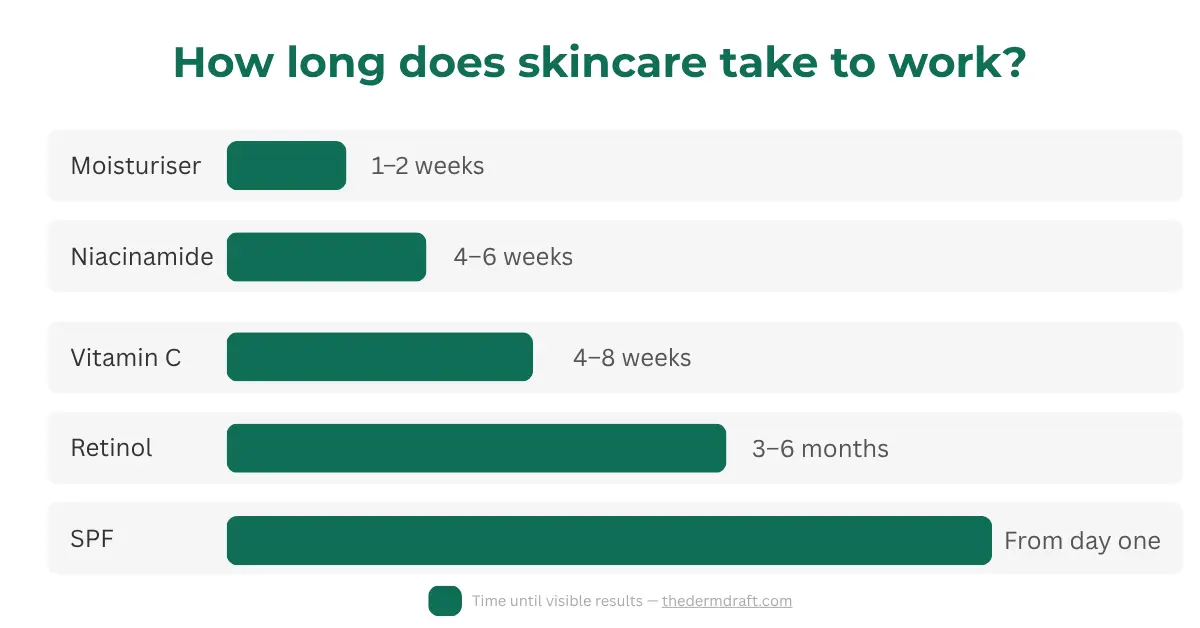
Different products operate on completely different timescales and lumping them together is one of the main reasons people give up too early.
Your moisturiser and your retinol are not on the same schedule, not even close.
Cleanser, You Feel It Immediately, But Real Change Takes Weeks
A cleanser does its main job immediately;skin feels clean, less congested, more settled. But if you’re using one to actually address something like persistent oiliness or blocked pores, four weeks of daily use is the honest minimum before you can assess whether it’s making any real difference.
In my own experience the first shift I noticed was that my skin stopped feeling tight and squeaky-clean after washing, which happened around after two weeks but it took a full month before it felt genuinely settled rather than just slightly less irritated.
Moisturizer — Days to Feel It, Weeks to See It
Hydration is the one area where skincare moves fast. Dry or dehydrated skin responds to a good moisturiser within 24 to 72 hours. But actually visible changes, dry patches clearing up, texture improving, that oily-by-noon thing settling down, those take one to two weeks of consistent use to show up properly.
One thing worth knowing: people with oily skin often skip moisturiser because they think it’ll make things worse. In most cases it does the opposite. Dehydrated skin overcompensates by producing more oil, so using a lightweight non-comedogenic moisturiser every day can actually reduce excess oil over four to six weeks.
I’ve seen this happen in my own skin. It takes a bit of faith in the first two weeks when you feel like you’re making things greasier, but it usually evens out.
How Long Does Niacinamide Take to Work?
Niacinamide works on oil regulation, pore appearance, skin tone, and barrier function. But it does all of this gradually, not all at once.
A clinical study published on PubMed (Draelos et al., Journal of Cosmetic and Laser Therapy, 2006) found that topical 2% niacinamide significantly reduced sebum excretion rates after four weeks of use in one ethnic group and after six weeks in another.
In the first two weeks, you’ll probably notice nothing. Around week three, some people see less shine on their face throughout the day. The clearest results, like smaller-looking pores, a more even tone, and less congestion etc show up between weeks four and six.
One thing niacinamide sometimes does in the first couple of weeks is bring existing congestion to the surface, which looks like new breakouts. It’s not new — it’s old congestion clearing out faster than it would have otherwise, its an adjustment period. For a full breakdown of what’s happening and what to do, my guide on skin purging vs breakout covers this in detail.
How Long Does Retinol Take to Work?
Three to six months. That’s the real answer. Not what you want to hear, probably, but it’s accurate. Retinol is the most clinically supported over-the-counter ingredient for long-term skin changes and it’s also the one with the most abandoned bottles because people quit at week three when their skin is peeling and they’re convinced they’ve made things worse.
| Timeline | What’s actually happening |
| Week 1-2 | Your skin will probably get worse. Dryness, some peeling, maybe a breakout or two. This is normal and most people quit here |
| Week 3-4 | The flaking starts to settle. Skin is building tolerance. Still no visible payoff |
| Month 2-3 | Texture starts feeling different — smoother to touch, less congested. You’ll notice it before anyone else does |
| Month 3-4 | Fine lines soften. Especially around the eyes and forehead. Not gone, but less sharp |
| Month 4-6 | Tone evens out. Dark spots fade. Skin looks and feels measurably different from where you started |
| 6 months+ | Benefits keep building. Month nine looks better than month three |
For a deeper look at where retinol sits in the vitamin A family and why retinaldehyde often gives faster results with less discomfort, retinaldehyde vs retinol: the missing middle step, covers the full comparison.
The first month is genuinely uncomfortable for a lot of people. Start at the lowest concentration you can find (0.025–0.05%), use it once or twice a week, and don’t increase frequency until your skin has stopped reacting. The peeling phase is temporary. The long-term results aren’t.
Vitamin C — For Brightness
Vitamin C is mainly used for brightening and protecting against damage from free radicals. Most people notice gradual improvements in radiance and evenness after four to eight weeks of consistent morning use. Dark spots may require three to four months.
Vitamin C is deactivated by sunlight, which is why you must wear SPF every morning when using it. Without SPF, you undo the brightening effects of the serum.
If vitamin C alone isn’t moving stubborn pigmentation fast enough, tranexamic acid runs on a similar 8-to-12-week timeline, just through a completely different mechanism
SPF — Effective From Day One, Transformative Over Years
SPF is the only product in your routine that gives you zero short-term visual feedback. You apply it, nothing looks different. But the Skin Cancer Foundation estimates that UV-induced damage (photoaging) accounts for up to 90% of visible skin changes over time — wrinkles, dark spots, loss of firmness.
The US Environmental Protection Agency puts the figure similarly. Consistent daily SPF is quietly doing more for how your skin will look in ten years than any serum you own, even though it gives you nothing to look at today
Why Skin Gets Worse Before It Gets Better
This is the part that causes the most unnecessary product-abandonment. You start using a new active ingredient, and within a couple of weeks you’re breaking out worse than before you even started. So obviously you stop.
What’s actually happening: active ingredients like retinoids, AHAs, BHAs, and sometimes niacinamide speed up cell turnover. Congestion that was sitting deep in your pores gets pushed to the surface faster than your skin would normally expel it, and from the outside that looks like a sudden explosion of new breakouts. But it isn’t new, it’s old stuff leaving faster.
According to Dermatica’s dermatologist-reviewed guidance on retinoid purging, this phase typically lasts two to eight weeks, with visible improvement usually starting around week six for people who stick with the product.
The rough rule: if the breakouts appear where you’d normally get them and slowly improve week by week, you’re purging — keep going. If they appear somewhere completely new, don’t improve even after eight weeks, or come with burning or anything rash-like, stop. That’s a reaction, not an adjustment, and the distinction matters. My guide on skin purging vs breakout explains every scenario and tells you what to do in each case
Skincare not working — how long should you actually wait?
Before you stop using a product, there are really only a few questions worth asking yourself.
- Have you been using it consistently for at least six weeks?
- For retinol, is it closer to three to four months? Because if not, the product hasn’t actually had enough time and you genuinely can’t know yet.
- Are you using it correctly — the right amount, the right order, suited to your skin type? A heavy cream on oily skin or retinol used every night before your skin has built any tolerance creates problems that look like product failure when it’s the application that’s off.
- And has anything changed at all, even slightly? Look at weekly photos in consistent lighting. Less reactive? Holding moisture better? Breaking out slightly less over the past month?
Those small shifts mean something is working even if the mirror isn’t giving you the dramatic before-and-after you were hoping for. If you’ve genuinely been consistent and correct for twelve weeks and there’s been zero observable change of any kind, then yes, that product probably isn’t right for your skin. Twelve weeks is the honest cutoff for actives. Four weeks is enough to evaluate a moisturiser. Walking away after ten days isn’t a fair evaluation of anything.
Signs Your Routine IS Working (Even If You Can’t See It Yet)
Visible skin changes lag behind functional ones by weeks sometimes. Your skin can be genuinely improving while the mirror still shows you the same thing. Less tightness after cleansing is one of the earliest signals that your skin barrier is getting healthier, a lot of people don’t notice it until it’s gone and then they can’t believe they ever tolerated that squeaky, stripped feeling.
Lower sensitivity to wind or temperature changes is another. Hydration that lasts through the day without touch-ups. Fewer small random breakouts across a rolling four-week window, even if the individual ones still look the same. Texture that feels smoother under your fingers before it appears smoother in any photo.
Any one of those is real progress. Don’t dismiss it just because your dark spots look unchanged.
When to Actually Give Up on a Product and Move On
Patience has a limit and some signals genuinely mean stop, not wait.
Stop if twelve weeks of consistent correct use has produced zero change of any kind. Stop if you experience burning or stinging that doesn’t calm down within a few days. Stop if breakouts appear in areas you’ve never broken out before and don’t improve after eight weeks.
Stop immediately if you develop redness, swelling, hives, or anything that looks like a rash — that’s an allergic reaction, not adjustment. And if your skin barrier feels genuinely damaged, raw, excessively flaky, painfully tight, go back to the simplest possible routine (gentle cleanser, ceramide moisturiser, SPF) and let everything settle before you try introducing anything active again.
If you’re still building your basic routine, my minimum skincare routine for beginners explains when your skin is ready to add new products and what signs to look for first to avoid mistakes.
How to Track Your Skin Progress Without Obsessing Over It Daily

Checking your skin in the bathroom mirror every morning and making judgements based on that day is unreliable. Your skin changes daily based on sleep quality, stress, hormones, water intake, whether you were outside.
The method that actually works: one photo a week, natural light, same angle, same time of day. Three lines of notes, what you used morning and night, and one observation about how your skin felt (oily, calm, reactive, tight).
That’s genuinely all you need. After four weeks, put your first photo next to the most recent one. Month-to-month changes are often surprising in the best way, even when day-to-day felt like nothing was happening.
This is the method I used during my 30-day skincare routine tracking. After 30 days, reviewing those notes tells you much more than your memory could.
A quick note on climate, hormones, and skin tone
Most skincare timeline advice is written for temperate climates. If you’re in South Asia, the Middle East, or anywhere with high heat and humidity year-round, your timeline may genuinely differ. High humidity changes how quickly products absorb and how long SPF stays effective, heavier creams in particular often sit on the surface rather than absorbing, which can make a routine feel like it’s underperforming when it’s really just a texture mismatch.
Hormonal cycles also mess with timelines more than most skincare content acknowledges. If you have PCOS, hormonal acne, or are going through perimenopause, the baseline keeps shifting, which means retinol and acne treatments can take longer to show consistent results because the hormonal disruption keeps moving the goalposts.
For deeper skin tones, dark spots and hyperpigmentation take longer to fade because melanin production ramps up more readily in response to inflammation. Three to six months is a completely realistic minimum timeline for vitamin C or niacinamide working on dark spots, not a sign that nothing is happening.
Frequently Asked Questions
How long does a skincare routine take to show results?
A basic routine, cleanser, moisturiser, SPF — shows behavioral improvements like better hydration and less tightness within one to two weeks, visible changes within four to six. Niacinamide needs four to six weeks. Retinol needs three to six months.
Is it normal for skin to look worse when starting a new routine?
Yes, especially with retinoids, AHAs, and BHAs. These speed up cell turnover and push congestion to the surface. It typically clears within four to six weeks.
How long does retinol take to work?
Three to six months for visible results on fine lines, texture, and dark spots. Mild flaking and sensitivity in the first few weeks are normal. Start low, go slow on frequency.
How long does niacinamide take to work?
For oil and pore appearance, it takes four to six weeks. For dark spots, eight to twelve weeks. Consistent daily use at 5% beats occasional use at a higher percentage.
My skincare isn’t working — how long should I wait?
Twelve weeks for actives, assuming consistent correct use. Four weeks for a basic moisturiser. Ten days for anything is not a real evaluation.
Does expensive skincare work faster?
No. Skin cell turnover runs on its own biological schedule regardless of price. Same active ingredient, same percentage, budget and premium brands show results on the same timeline.
Can better sleep or diet make skincare work faster?
Yes, genuinely. Skin repairs itself during sleep and chronic poor sleep drives inflammation that slows cell turnover. Staying hydrated and eating foods with antioxidants supports the whole process.
The short version
How long does skincare take to work? It’s longer than you see on Instagram and shorter than you feel during those dull middle weeks.
Four to six weeks before most active ingredients show behavioral changes. Three to six months before you see significant visible improvement in texture, dark spots, or fine lines.
Most routines don’t fail, people just stop somewhere around week two or three, right before things are about to change.
If you’ve been tracking with weekly photos and you can see even small improvements in how your skin behaves, less reactive, holds moisture longer, fewer breakouts — your routine is working. Keep going.
Related Articles
- 30-day skincare routine results: what actually changed week by week
- Skin purging vs breakout: how to tell why your skin gets worse
- Minimum Skincare Routine: The only 3-product skincare routine beginners actually need
- Retinol vs Retinaldehyde: a guide on the difference between different derivatives of Vitamin A
- Tranexamic acid: what its own realistic timeline looks like, and how it compares to vitamin C for stubborn pigmentation
Sources
- Journal of Clinical and Aesthetic Dermatology — Review on cosmeceutical ingredients and niacinamide’s skin-lightening timeline
- Journal of Cosmetic and Laser Therapy (2006) — Study on 2% niacinamide reducing facial sebum production within 4–6 weeks
- Skin Cancer Foundation — Photoaging guide explaining that up to 90% of visible skin aging is caused by UV exposure
- US Environmental Protection Agency — Health effects of UV radiation highlighting its major role in premature skin aging
- Dermatica SkinLab — Dermatologist-reviewed guide on retinoid purging timelines and peak breakout phases
About the Author
Hi, I’m Sidra.
I’m not a dermatologist or any kind of skincare pro, I’m just someone like you, who got sick of constantly switching up products and never having a clue what was really working. After years of trial and error, I decided to focus on one thing: consistency.
I test routines on myself, I track results in detail, and I write about what realistically shifts and what doesn’t. My aim is to dispel hype and discuss skin-care the way I would with a friend: practical, honest, and backed by patience instead of promises.
Skin type: Normal to dry skin with mild sensitivity
The information in this article is for educational purposes only and does not replace professional dermatological advice. If you have a specific skin condition or concern, please speak with a qualified healthcare provider.