

KEY TAKEAWAYS
- Non-comedogenic is not regulated by the FDA, the EU, or any governing body. Any brand can print it on a product without testing
- The 0-5 comedogenic scale comes from rabbit ear tests run in the 1970s. Rabbit ear skin reacts very differently from human facial skin
- Your SPF and moisturiser are far more likely to cause congestion than your cleanser. They stay on your skin for hours. Your cleanser rinses off in seconds
- A product with all 0-rated ingredients can still cause breakouts through irritation. Comedogenic and irritant breakouts are two different mechanisms
- No brand paid for inclusion here. No affiliate links. No sponsored content
What does non-comedogenic mean?
Non-comedogenic means a product is formulated to reduce the risk of clogging pores and triggering comedones. The term has no legal definition anywhere in the world. No regulatory body, including the FDA and the EU, defines or tests for it. Any brand can print the label without a single test. The ratings behind the claim come from a 1970s scale built using rabbit ears, not human facial skin. The label is a marketing term, not a safety guarantee.
You picked the moisturiser because the label said it was non-comedogenic. You switched to the non-comedogenic SPF. You’ve been careful about every product for months.
And you’re still breaking out.
Non-comedogenic is one of the most misleading terms in skincare. Not because brands are dishonest. Because the term has no legal definition, no testing requirement, and no governing body that checks whether it means anything at all.
I found this out the hard way. My entire routine was labelled non-comedogenic. My skin stayed congested for months. One ingredient in my SPF, rated 4 on the comedogenic scale, turned out to be the cause. The label said safe. The ingredient list told a different story.
If you’ve switched products repeatedly but still feel constantly congested, this is probably the missing context .
This article covers what the term was supposed to mean, why it’s unreliable, how to read an ingredient list instead, and what to do when even that doesn’t fix it.
What Non-Comedogenic Was Supposed to Mean
The concept started in 1972. Dermatologists Dr. Albert Kligman and Dr. Otto Mills published a paper in the Archives of Dermatology describing what they called acne cosmetica: cosmetics causing low-grade acne, mostly closed comedones on the cheeks and chin, in people who were not otherwise acne-prone.
From that work came the 0-5 comedogenic scale. Ingredients rated 0 were unlikely to clog pores. Ingredients rated 5 almost certainly would. Products formulated without high-rated ingredients could carry the non-comedogenic label. The intention made sense. The execution had a problem from the start.
The Rabbit Ear Test
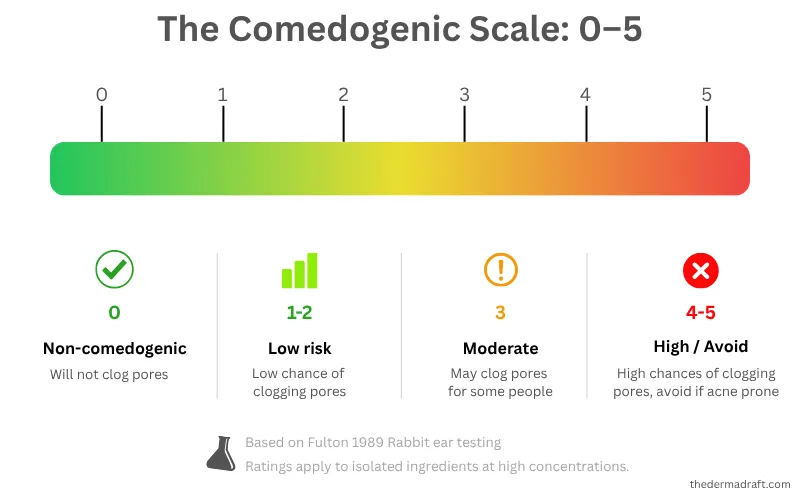
Almost all the original ratings came from tests on the inner skin of rabbit ears. Researchers applied ingredients and measured follicular plugging. The thin, sensitive rabbit ear skin made results fast to observe. That same sensitivity is the problem.
A 2025 peer-reviewed review published in JAAD Reviews confirmed what earlier studies had shown: rabbit ear skin reacts far more strongly than human facial skin. Ingredients that caused comedone formation on rabbit ears did not always produce the same result on human skin. The false positive rate is high, and the method was never replaced with a standardised human equivalent.
Most of the 0-5 ratings people check online today come from those 1970s tests. The method is older than most of the readers using it.
Why the Non-Comedogenic Label Is Largely Unregulated
No legal definition anywhere
The FDA does not define, regulate, or test for the non-comedogenic claim on cosmetics. Neither does the EU Cosmetics Regulation. No test is required before printing the label. No third party checks whether a brand’s testing was rigorous or nonexistent.
A 2025 paper published in JAAD Reviews stated this plainly: the lack of regulatory oversight allows companies to label products as non-comedogenic regardless of their actual potential to cause acne. This gap has been raised by dermatologists for decades. No governing body has addressed it.
The formulation problem
A 2006 re-evaluation study in the Journal of the American Academy of Dermatology found that finished products using comedogenic ingredients are not necessarily comedogenic. How ingredients interact in a formula, their concentrations, and the emulsion type all affect how each one actually behaves on skin.
An ingredient rated 4 in isolation may behave very differently at 0.5% in a water-based product.
What testing looks like now, and why it’s still imperfect
The method that replaced rabbit ears applies products to the upper back under an occlusive patch for several weeks, then counts comedone formation in biopsy samples. More relevant than rabbit ears, but still imperfect.
Back skin is not facial skin. It’s thicker, has larger follicles, and produces sebum differently from your cheeks or chin. Results on the back don’t translate to where most cosmetic acne appears. The regulatory gap and the testing gap are both still there.
Why Concentration and Contact Time Matter More Than the Rating
This is the part most guides skip, and it might be the most practical thing in this article.
Comedogenicity ratings test ingredients in isolation, often undiluted. Real products dilute those ingredients into thin layers. Acetylated lanolin alcohol rates 4-5 at full strength. At 2.5% diluted, it drops to 1. Same ingredient. Very different risk at real-world concentrations.
Contact time matters just as much. Your cleanser rinses off in under a minute. Your SPF sits on your skin all day. A moderately comedogenic ingredient in a rinse-off cleanser is a very different risk from the same ingredient in your daily sunscreen.
The Ingredients Most Likely to Break You Out That Hide in Safe-Labelled Products
Here’s something that surprises most people: some of the most comedogenic ingredients on the scale are natural.
Coconut oil rates 4-5 and appears in natural moisturisers and hair products that drip onto your hairline. Wheat germ oil rates 5, the maximum. Algae and seaweed extracts often rate 4-5. Cocoa butter rates 4. Meanwhile, mineral oil, which many people avoid because it sounds synthetic, has a comedogenic rating of 0. Dimethicone and most silicones rate 0-1.
The assumption that natural means safer for your pores is one of the most consistent reasons people stay congested despite choosing clean products.

| Ingredient | Rating | Commonly Found In | What to Know |
| Coconut Oil | 4-5 | Natural moisturisers, DIY balms, hair oils | Avoid on the face; safe for body and hair |
| Isopropyl Myristate | 4-5 | Foundations, body lotions, some SPFs | One of the most well-studied pore-clogging ingredients |
| Algae / Seaweed Extract | 4-5 | Marine skincare, anti-ageing serums | Check the specific type on CosDNA |
| Wheat Germ Oil | 5 | Natural face oils, vitamin-enriched skincare | Maximum rating on the scale |
| Cocoa Butter | 4 | Body creams, natural balms, some moisturisers | Fine on body skin; problematic on the face for many |
| Sodium Lauryl Sulphate | 0-1 (not comedogenic) | Foaming cleansers, shampoos | Causes irritant breakouts, not clogged pores. A different mechanism entirely. |
| Mineral Oil | 0 | Cleansing balms, some moisturisers | Often feared but does not clog pores on human facial skin |
That SLS row matters. It doesn’t block pores. It causes a different type of breakout through a completely different mechanism, which is what the next section covers.
Two Mechanisms, Two Types of Breakouts
Most people assume ‘broke me out’ means one thing. It actually describes two separate processes that look almost identical but need completely different fixes.
The first is comedogenic breakouts. A pore-clogging ingredient builds up in the follicle, traps sebum, and creates a blockage. The result is closed comedones, blackheads, or slow-forming spots that cluster in one area. This is what the comedogenic scale was designed to measure.
The second is irritant breakouts. The product doesn’t block pores. It disrupts your skin barrier through chemical irritation: harsh surfactants, pH imbalance, fragrance, or preservatives. When the barrier breaks down, acne-causing bacteria get in more easily. The breakout looks like acne. The cause is barrier damage, not a clogged follicle.
A product can have an all-0 ingredient list and still cause breakouts through the second mechanism. This is exactly why someone can check everything on CosDNA, see ratings of 0-2, and still break out.
The guide on rough bumpy skin that isn’t acne covers the four conditions most people misidentify, including closed comedones, milia, and keratosis pilaris, each of which needs a different fix.
How to Actually Read a Skincare Ingredient List
The ingredient list is the most reliable information on any skincare label. The front of the packaging is marketing. The ingredient list is the formula.
The position rule
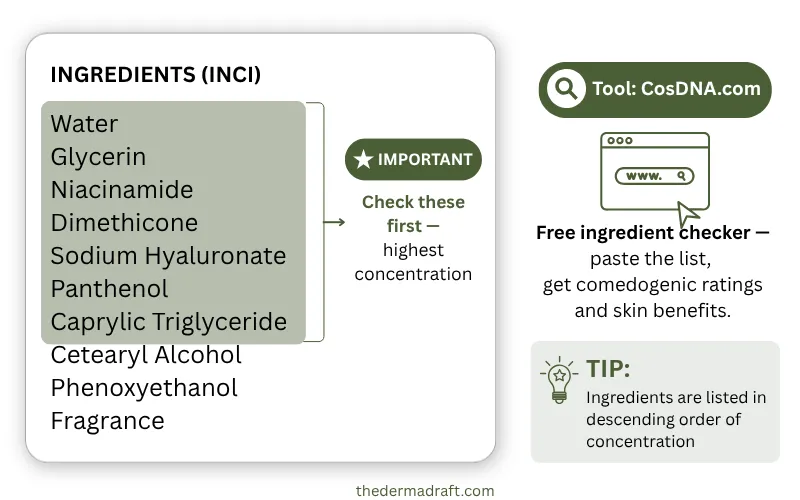
Ingredients are listed in descending order of concentration. The first five to seven make up most of the formula. An ingredient at position 2 is in far greater amounts than one at position 18. If a highly comedogenic ingredient rated 4 or 5 appears in the top seven, the product carries real risk for pore congestion. The same ingredient near the bottom may be at concentrations too low to cause a practical problem.
How to use CosDNA
CosDNA.com is free. Paste any ingredient list and it returns comedogenicity and irritancy ratings for each ingredient. It takes about two minutes per product. The database reflects the historical ratings from the 1970s and shares their limitations, but it’s the most practical starting point available.
INCIDecoder is another free option that works the same way, and it links each ingredient back to the original Fulton scale source data if you want to see where a rating actually came from.
Keep in mind: CosDNA rates ingredients in isolation and can’t account for how they interact in a full formula. Ratings of 2-3 are a judgment call. They may affect oily, large-pored skin differently from dry skin. Use it as a starting point, not a verdict.
Leave-on versus rinse-off: the distinction most guides miss
Your SPF wears against your skin for 8 to 12 hours. Your cleanser is in contact for under a minute. The risk profile of the same ingredient is completely different across those two product types. When auditing your routine, start with leave-on products: your moisturiser and your SPF. Most people check their cleanser first. Most of the time, that’s not where the problem is.
When You’ve Checked Everything and Still Break Out
You’ve read every ingredient list. You’ve checked ingredients on the ingredient checker . You switched to products that rate well but you’re still congested.
At that point, the problem is probably not a pore-clogging ingredient.
The application method is worth considering. Rubbing rather than pressing can push residue into pores more forcefully. Applying too much product creates a layer that doesn’t fully absorb.
Your pillowcase, phone screen, and hair products are three of the most overlooked non-product triggers. Breakouts on one side of your face, along the jawline, or in a band where your phone rests during calls are rarely caused by your skincare.
The guide on why you’re still breaking out with a consistent skincare routine covers these hidden causes and the step-by-step elimination process.
Skin type affects everything. Ingredients rated 2-3 may affect very oily, large-pored skin in ways they wouldn’t affect dry skin. The comedogenic scale was never designed to account for individual variation. Your skin’s response over four weeks remains the most accurate test available.
If you still can’t find the cause, the guide on how to build a skincare routine when you’ve already tried everything covers the two-week reset: strip back to cleanser, moisturiser, and SPF, then add things back one at a time.
Frequently Asked Questions
What does non-comedogenic mean in skincare?
Non-comedogenic means a product is formulated to reduce the likelihood of clogging pores. The term refers to the 0-5 comedogenicity scale, where ingredients rated 0-2 are considered unlikely to block pores. No regulatory body defines or enforces the label. Any brand can use it without conducting any testing.
Why does a non-comedogenic product still break me out?
Two reasons. The comedogenic scale is based on 1970s rabbit ear tests that don’t translate to human facial skin. Also, non-comedogenic only measures pore-clogging potential, not irritant reactions. Both mechanisms cause breakouts but need completely different fixes.
What is the comedogenic scale and how reliable is it?
The scale rates ingredients from 0 to 5 based on pore-clogging potential, developed from rabbit ear tests in the 1970s. A 2025 review in JAAD Reviews described the methodology as fundamentally flawed for predicting real-world human skin behaviour. Rabbit skin reacts far more strongly than human skin, and ingredients were tested in isolation at high concentrations.
Is non-comedogenic the same as oil-free?
No. Oil-free means no added oils. Non-comedogenic means formulated to avoid pore-clogging. An oil-free product can still contain isopropyl myristate. A product with jojoba oil (rated 2) or squalane (rated 1) can be non-comedogenic. The two claims describe different things and don’t automatically overlap.
How do I check if a product will actually clog my pores?
Paste the full ingredient list into CosDNA.com. It assigns comedogenicity and irritancy ratings to each ingredient. Focus on the first seven positions. For leave-on products like your SPF and moisturiser, any ingredient rated 4-5 in the top seven is worth investigating if you’re acne-prone.
Can a product with all 0-rated ingredients still cause breakouts?
Yes. Comedogenicity only measures pore-blocking potential. A product where all ingredients rate 0 can still cause breakouts through fragrance sensitivity, preservative reactions, or pH-related barrier disruption. If a product checks out on an ingredient audit tool but your skin reacts, the issue is almost certainly irritancy.
Why does my SPF break me out even when it says non-comedogenic?
SPF stays on your skin all day, making it the highest-risk product for pore congestion in most routines. Even moderate comedogenic emollients build up over hours of contact. Check specifically for isopropyl myristate and algae extracts. A mineral SPF with a short ingredient list is the fastest way to test whether your sunscreen is the cause.
When should I see a dermatologist about comedone-related breakouts?
If you’ve audited your products and your skin is still consistently congested after 8 to 12 weeks of a careful routine, see a dermatologist. Deep cystic acne, breakouts that leave marks, and skin that doesn’t respond to any logical change are beyond what ingredient checking can solve on its own.
The Bottom Line
Non-comedogenic is not a promise. It’s a marketing term with no legal backing, built on a scale from rabbit ear tests decades ago.
The label can point you in a useful direction, but relying on it as a guarantee is what leaves people confused when safe-labelled products keep breaking them out.
The ingredient list is the most reliable tool you have. Check leave-on products first. Look at the top seven positions. Use ingredients checker as a reference, not a verdict. If everything checks out but your skin still reacts, the cause is likely irritation, a lifestyle trigger, or individual variation the scale was never designed to predict.
For many people, one ingredient audit on CosDNA is enough to identify likely triggers. The non-comedogenic label won’t tell you. The ingredient list usually will.
Related Articles
- Why you’re still breaking out with a consistent skincare routine — covers hidden triggers like pore-clogging SPF, dirty pillowcases, and conflicting actives that most guides skip
- Rough bumpy skin that isn’t acne– 4 types of skin conditions that is not acne & the causes
- How to build a skincare routine when you’ve already tried everything – the two-week reset method for starting with a clean baseline when product audits alone don’t explain a stubborn breakout
Sources
- Archives of Dermatology— Acne cosmetica
- Journal of the American Academy of Dermatology — A re-evaluation of the comedogenicity concept
- JAAD Reviews. 2025 — Comedogenicity in cosmeceuticals: A review.
- INCIDecoder — Comedogenic ratings and the Fulton scale reference
- FDA — Cosmetics labelling claims: noncomedogenic
About the Author
Hi, I’m Sidra.
I’m not a dermatologist or any kind of skincare pro, I’m just someone like you, who got sick of constantly switching up products and never having a clue what was really working. After years of trial and error, I decided to focus on one thing: consistency.
I test routines on myself, I track results in detail, and I write about what realistically shifts and what doesn’t. My aim is to dispel hype and discuss skin-care the way I would with a friend: practical, honest, and backed by patience instead of promises.
Skin type: Normal to dry skin with mild sensitivity
The information in this article is for educational purposes only and does not replace professional dermatological advice. If you have a specific skin condition or concern, please speak with a qualified healthcare provider.