

KEY TAKEAWAYS
- Hyaluronic acid draws water into skin — but in a dry room it can pull from your own skin. Apply to damp skin and seal with moisturiser on top
- Niacinamide takes 8 to 12 weeks to show real results. Most ads say two weeks. The research doesn’t
- Retinol gets worse before it gets better. Dryness and flaking in weeks 1 to 4 are normal. Don’t stop
- All three are compatible. They do not cancel each other out. That is an outdated myth
- For most beginners, niacinamide is the best first active. It suits almost every skin type and needs no slow introduction
- Don’t start all three at once. Introduce one every four weeks so you can tell what’s working and what isn’t
Can you use niacinamide, hyaluronic acid, and retinol together?
Yes. All three are compatible and work well in the same routine. The correct order is: gentle cleanser, hyaluronic acid serum on slightly damp skin, niacinamide serum, moisturiser. Retinol goes in your evening routine only as the final step. If you’re new to retinol, start at 0.025% twice a week and build from there.
Walk into any pharmacy or scroll any skincare account and these three words follow you everywhere. Niacinamide, hyaluronic acid, retinol. Almost every serum & Every beginner starter kit carries at least one of them & yet the actual explanation of what they do, the mechanism, the timeline, the honest caveats, almost never makes it into the same article.
I spent close to six months using niacinamide before I could have told you exactly why. I’d added it because every article said so, which is how most people build their first routine and exactly why those routines tend to fall apart.
In this guide we’ll cover what niacinamide, hyaluronic acid, and retinol are actually doing inside your skin, which specific concerns each one addresses, the honest limitation of each that most content skips, whether all three can work together, and where to start if you can only handle one at a time.
Why These Three Ingredients Are on Everything Right Now
Interest in skincare actives has grown dramatically over the past several years. Google Trends data consistently places retinol among the most searched cosmeceutical terms globally, while hyaluronic acid and niacinamide have both seen sustained search growth.
These are now mainstream terms, not specialist dermatology language. The problem is that the content explosion around them created more confusion than clarity. One article tells you to use niacinamide before retinol. Another says they cancel each other out.
They can’t all be right, and most beginners have no way to know which one to trust. This guide is where to start.
Hyaluronic Acid: The Hydration Ingredient
Hyaluronic acid is a moisture-binding molecule that draws water into the skin and keeps it there.
That’s the whole job. It doesn’t rebuild your barrier, fight acne, or brighten uneven tone. When your skin is dehydrated, fine lines look deeper, texture looks rougher, and everything feels tight throughout the day. Hyaluronic acid targets that specific problem.
What It Is and How It Hyaluronic Acid actually Works
Hyaluronic acid belongs to a class of ingredients called humectants, substances that attract and hold water molecules. Your body makes it naturally in connective tissue and skin, but output slows with age and dry environments accelerate that decline.
A topical HA serum essentially restores what the skin would otherwise make itself.
The molecular weight of HA determines how deep it penetrates. Larger molecules create a film at the skin’s surface, slowing evaporation. Smaller molecules reach deeper layers and work from within.
Products labelled ‘multi-molecular’ contain both weight variants, which is why they tend to outperform single-weight formulas on extended wear. This is confirmed in a review by Papakonstantinou et al. (2012) on HA’s role in skin ageing.
What Nobody Tells You About Hyaluronic Acid
As a humectant, hyaluronic acid works by seeking out water to bind to. In humid conditions, it draws that moisture from the surrounding air, which is exactly what you want. The problem comes in dry environments, a heated room in winter, air conditioning, low-humidity climates, where there’s little atmospheric moisture to grab.
In those conditions, the molecule turns inward, pulling water up from the deeper layers of your own skin toward the surface, where it can evaporate.
If you’ve ever applied HA and felt drier an hour later, that’s the mechanism at work.
The practical fix: apply HA immediately after cleansing while your skin still carries moisture from rinsing, then apply moisturiser on top before the skin fully air-dries. The moisturiser traps the water the HA has pulled in. Without that seal in dry climates, application can leave your skin worse than before.
Common Mistakes With Hyaluronic Acid
Applying to completely dry skin and skipping moisturiser on top is the most common error. The second is using HA to fix dryness caused by a damaged barrier, a disrupted barrier needs ceramides first, not humectants.
If your cleanser might be stripping your skin, the guide on what your cleanser might be doing to your skin’s barrier is worth reading before adding any new actives.
Niacinamide: Vitamin B3’s Multi-Tasking Role in Skin
Niacinamide is a form of vitamin B3 that regulates oil, calms redness, fades pigmentation, and strengthens your skin barrier.
It’s the one ingredient on this list that does several things at once, which is why it ended up in almost every product category.
What Does Niacinamide Do to Your Skin
Niacinamide is water-soluble and stable in most formulas, making it easy for your skin to tolerate. It reduces oil production by signalling sebaceous glands to slow down, which is why regular use makes pores look smaller over time.
Pores appear enlarged when they fill up with excess sebum. It strengthens the barrier by increasing ceramide production, the fatty molecules that keep skin cells bonded together and stop moisture from escaping. It calms redness and inflammation, making it suitable for both acne-prone and sensitive skin (Bissett et al., 2005).
It also slows melanin transfer to the surface, which is the mechanism behind fading post-acne marks and uneven tone.
If you’re using niacinamide alongside vitamin C, the two actually target pigmentation from different directions, the full breakdown is in the guide on using niacinamide and vitamin C together. If that combination alone isn’t touching stubborn melasma or acne marks, tranexamic acid works through a third pathway entirely and deserves its own read.
A study published in the Journal of Cosmetic and Laser Therapy (Draelos et al., 2006) confirmed that 2% niacinamide measurably reduced facial sebum production
The Honest Truth About Niacinamide Results
Eight to twelve weeks is the evidence-backed timeline for visible improvement. Not two weeks, which is what most product ads imply.
Your skin completes a full renewal cycle roughly every 28 days, and the changes niacinamide drives in sebum regulation, ceramide production, and melanin transfer each require multiple full cycles to accumulate at the surface.
Most people stop around week three. That is statistically when the results would be closest to starting but the wait has not paid off yet, which makes it the worst possible moment to quit.
Which Concentration Is Worth Using
Research supports the 2% to 10% range. Most well-formulated serums sit at 5% and that’s the sweet spot, full documented benefits without the mild flushing that occasionally appears above 10%
Products marketed at 15% or 20% have no published clinical evidence showing outcomes better than 10%.
Common Mistakes With Niacinamide
Starting above 5% on reactive or sensitive skin. Stopping before the 8-week minimum because nothing visible has happened yet. Using it as a targeted spot treatment rather than applying it across the full face. Niacinamide works through gradual systemic change, not localised action.
If your skin is already reactive, ingredient choice isn’t the only thing that matters. Fragrance can also contribute to irritation, especially while your skin barrier is recovering. My guide on fragrance in skincare explains when scented products are perfectly fine and when they’re more likely to become a problem.
Retinol: The Gold Standard for Skin Renewal
Retinol is a vitamin A derivative that accelerates how quickly your skin turns over its cells and stimulates new collagen in the deeper dermal layer.
It has more clinical backing than almost any other over-the-counter skincare ingredient.
What Does Retinol Do to Your Skin
Retinol sits within a family called retinoids. Prescription options like tretinoin work faster because they’re already in the form your skin needs. OTC retinol requires your skin to convert it into retinoic acid after absorption, making it slower but considerably gentler.
A 2006 review in Clinical Interventions in Aging (Mukherjee et al.) identified retinoids as the most clinically supported topical for reducing fine lines, improving texture, boosting collagen, and treating hyperpigmentation. Nearly 20 years later that conclusion hasn’t changed.
The Adjustment Period Nobody Adequately Prepares You For
For most first-time users, the first four weeks of retinol look worse than before they started. When cell turnover accelerates, your skin has not yet adapted to operating at that new pace.
The backlog of congestion gets pushed out faster than usual, which shows up as flaking, dryness, and temporary breakouts. Dermatologists call this the retinol adjustment period and it is a normal physiological response, not a sign of damage.
The adjustment phase peaks in weeks two and three, which is exactly when most people abandon the ingredient. Stopping at that point means absorbing all the early discomfort while missing every result that follows it.
How to Introduce Retinol Without Barrier Damage
Start at 0.025% to 0.05%. Use it twice a week in your evening routine only, never morning. UV light degrades retinol and it raises photosensitivity, so SPF the next morning is non-negotiable. After four weeks with no serious reaction, move to every other night.
If you’ve sensitive skin & afraid to start retinol, you can give a try to Bakuchiol which is a suitable alternative to retinol without being harsh. If you’re curious whether plant-based alternatives like bakuchiol hold up against retinol, the full origin story and price comparison is in why western brands are quietly copying Asian skincare ingredients.
Starting retinol at 1% immediately is one of the most reliable ways to damage your barrier by week three.
If you’ve built tolerance to retinol but results have plateaued, or want a faster-acting OTC option, retinaldehyde vs retinol: the missing middle step explains exactly where retinaldehyde fits between retinol and prescription tretinoin.
If you’re not clear on why retinol must stay in the evening, why your morning and night routines should use different products explains the photochemistry behind it.
The Skin-Thinning Myth, Cleared Up
Retinol does not thin your skin over time. It thins the outermost dead cell layer, which refines texture. The living dermis underneath actually becomes thicker with consistent use because retinol stimulates collagen production in those deeper layers. Mukherjee et al. (2006) confirmed this in their clinical review.
Can You Use Niacinamide Hyaluronic Acid Retinol, all in the Same Routine?
Yes, all three are compatible. The persistent claim that niacinamide and retinol cancel each other out has been traced back to older literature involving niacin (a different compound) reacting with retinol under heat. That research has been widely misread and passed around secondhand for years.
Brands including The Ordinary have published detailed responses to this myth, noting that no peer-reviewed evidence supports the idea that topical niacinamide reduces retinol efficacy. In practice, the opposite tends to be true: niacinamide’s barrier-supporting and anti-inflammatory properties can soften some of the irritation retinol causes during the initial adjustment weeks.
If you’re introducing retinol for the first time, it’s also worth paying attention to fragrance in the rest of your routine. My guide on fragrance in skincare explains why scented products can feel more irritating while your skin is adapting to retinoids.
The Correct Layering Order
Morning:
- gentle cleanser
- Hyaluronic Acid serum on skin that is still slightly damp from rinsing
- Niacinamide serum
- Moisturiser
- SPF last and always.
Evening:
- gentle cleanser
- Hyaluronic Acid serum
- Niacinamide
- Moisturiser
- retinol as the final step.
If you’re new to retinol or have reactive skin, try the sandwich method: HA, niacinamide, thin layer of moisturiser, retinol, second layer of moisturiser.
The buffer slows absorption slightly and reduces irritation in the early weeks.
Full Ingredient Comparison Table
| Hyaluronic Acid | Niacinamide | Retinol | |
| What it does | Draws and holds water in skin | Regulates oil, fades marks, strengthens barrier | Speeds cell turnover, boosts collagen |
| Main concern | Dehydration and surface dullness | Oiliness, post-acne marks, uneven tone | Fine lines, texture, acne, pigmentation |
| Skin types | All skin types | All, especially oily or acne-prone | All, but needs slow introduction |
| When to use | AM and PM | AM and PM | PM only, never morning |
| Results timeline | Days (surface hydration) | 8 to 12 weeks | 3 to 6 months |
| Start at | 1 to 2% (multi-molecular better) | 5% sweet spot | 0.025 to 0.05% |
| Beginner-friendly | Yes | Yes, best first active | Yes, with careful intro |
A Real-World Illustration
The Ordinary built their product line around selling niacinamide, hyaluronic acid, and retinol as distinct serums so users know exactly what concentration they are applying at each step. The scale of their user base, millions of people running this combination daily, effectively demonstrates that all three work together without issue.
Where to Begin If You Can Only Handle One
For most beginners, start with niacinamide. It works across oily, dry, sensitive, and acne-prone skin without a slow introduction, without photosensitivity risk, and without triggering a purge. Morning and night from day one. If your skin’s main complaint is tightness after cleansing or a dull look by afternoon, hyaluronic acid is the better starting point because the result is noticeable within days. Retinol is the goal for most people eventually, but add it only after four weeks of stable, calm baseline skin. Introducing retinol onto an already-reactive barrier intensifies the adjustment period significantly.
The guide on building a complete routine as a total beginner covers the foundation to have in place before any actives.
One new active every four weeks. That interval gives you enough time to observe how your skin responds before adding anything else.
What to Realistically Expect in the First 30 Days
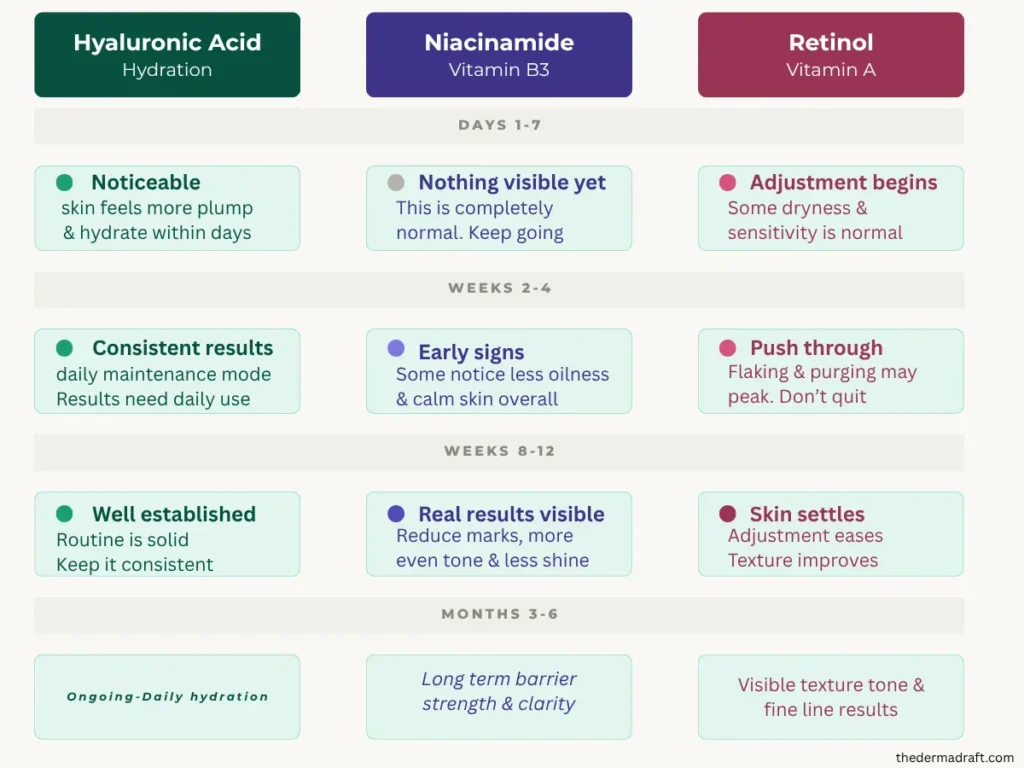
Hyaluronic Acid
Skin that was tight after cleansing should feel different within a few days of correct application. The visible effect, slight plumping and reduced shallowness of fine lines, is real but requires daily application to maintain. Think of it as ongoing management rather than something that produces lasting structural change.
If nothing shifts after a week, check the method: are you applying to skin that still has moisture from rinsing? Is moisturiser going on before the skin fully dries?
Niacinamide
Weeks 1 and 2, probably nothing visible. That’s completely normal. Around weeks 4 to 6, some people notice less shine and calmer skin. Visible changes in post-acne marks and tone typically start at 8 to 12 weeks. Week three is when most people quit. It’s also when you most need to keep going.
Retinol
Weeks 1 to 4 are often the roughest. Dryness, flaking, and a temporary increase in breakouts are all common as accelerated cell turnover pushes congestion to the surface.
If it feels intense, drop back to once a week, don’t stop completely. By weeks 5 to 8 most skin settles. Visible texture and tone improvements typically show up between months 3 and 6
Frequently Asked Questions
Can I use niacinamide, hyaluronic acid, and retinol all in the same routine?
Yes, all three are compatible. The correct evening sequence is HA on damp skin, then niacinamide, then moisturiser, then retinol last. The niacinamide cancels retinol claim has no support in current clinical literature.
Which one to apply first, hyaluronic acid or niacinamide?
Hyaluronic acid first, because it is thinner and benefits most from application to skin that still carries moisture. Niacinamide follows after HA has absorbed. If both are in one serum, the sequencing is already handled.
What does niacinamide actually do for skin?
It works on four pathways: slowing sebum production, increasing ceramide output to reinforce the barrier, reducing inflammation, and blocking melanin transfer that causes discoloration. Each benefit takes time because each runs through a different biological process.
Which active Ingredient should a beginner start with?
Niacinamide for most people. It accommodates all skin types, no photosensitivity risk, no purge period, no slow introduction needed. Hyaluronic acid is the right choice if dehydration is the primary concern. Retinol is worth adding eventually, but only once the skin is settled and stable.
How long does niacinamide genuinely take to work?
Eight to twelve weeks for visible changes to pigmentation and texture. Some people notice reduced oiliness earlier, around weeks four to six. Stopping before then means stopping before the ingredient has finished what it was doing.
Why is my hyaluronic acid not working?
Almost certainly an application method. When there is no atmospheric moisture available, HA pulls water upward from your own skin. That water then evaporates. Applying to slightly damp skin and sealing with moisturiser immediately fixes this.
Can I use niacinamide hyaluronic acid retinol, all three if I have sensitive skin?
Yes, with adjusted pacing. Hyaluronic acid is appropriate immediately. Niacinamide at 5% works well for most reactive skin types. Retinol at 0.025% once weekly is the safest entry point. If your skin is actively inflamed, wait until it settles before introducing retinol.
Why does my skin break out when I first start retinol?
Congestion below the surface is being pushed out faster than usual. Accelerated cell turnover brings old blockages up, which reads as new breakouts but is actually old congestion clearing. This is purging, it typically resolves within two to four weeks. Reduce frequency if necessary but do not stop entirely.
Does retinol thin skin over time?
No. The outermost dead cell layer thins, producing a smoother surface. The dermis beneath actually becomes thicker through collagen stimulation. Mukherjee et al. (2006) documented this directly. The thinning concern comes from confusing two different skin layers.
Can I use niacinamide and retinol on the same night?
Yes. They are compatible and niacinamide’s barrier support can reduce retinol’s irritation during the adjustment period. Niacinamide goes on first, retinol after it absorbs. In the sandwich method, niacinamide precedes the first moisturiser layer and retinol follows it.
The Bottom Line
Niacinamide, hyaluronic acid & retinol are three of the most research-backed actives in skincare. They work through different mechanisms and together they cover hydration, barrier health, oil regulation, pigmentation, and long-term renewal in one routine.
Start with the one that matches your biggest concern. Give it the full 8 to 12 weeks. Add the next one after four weeks of settled skin. The timeline isn’t a sign the products aren’t working. It’s the timeline the research has always described.
Related Articles
- How long skincare actually takes to work by ingredient: realistic timelines for every active, including what to do when nothing seems to be happening
- Why your morning and night routines should use different products: the biological reason certain ingredients belong at specific times of day
- Building a complete routine as a total beginner: the three-product foundation to have before adding any active ingredients
- 7 Skincare ingredients western brands quietly copied: A comparison of natural Asian skincare ingredients to costly Western skincare ingredients
- Niacinamide & Vitamin C together: A complete guide on whether these works together or not & if yes then How
- Retinaldehyde vs retinol: the middle step between OTC retinol and prescription tretinoin, and who should consider switching
- Fragrance in skincare — when scented products are completely fine, when they irritate your skin barrier, and how to know which category your skin falls into
- Tranexamic acid: the melasma and dark-mark ingredient that works through a completely different pathway than any of these three
Sources
- Journal of Cosmetic and Laser Therapy, 8(2), 96 to 101: Draelos, Z.D., Matsubara, A. and Smiles, K. (2006). The effect of 2% niacinamide on facial sebum production.
- Clinical Interventions in Aging, 1(4), 327 to 348: Mukherjee, S. et al. (2006). Retinoids in the treatment of skin aging: an overview of clinical efficacy and safety.
- Dermato-Endocrinology, 4(3), 253 to 258: Papakonstantinou, E., Roth, M. and Karakiulakis, G. (2012). Hyaluronic acid: A key molecule in skin aging.
- Dermatologic Surgery, 31(s1), 860 to 866: Bissett, D.L., Oblong, J.E. and Berge, C.A. (2005). Niacinamide: A B vitamin that improves aging facial skin appearance.
About the Author
Hi, I’m Sidra.
I’m not a dermatologist or any kind of skincare pro, I’m just someone like you, who got sick of constantly switching up products and never having a clue what was really working. After years of trial and error, I decided to focus on one thing: consistency.
I test routines on myself, I track results in detail, and I write about what realistically shifts and what doesn’t. My aim is to dispel hype and discuss skin-care the way I would with a friend: practical, honest, and backed by patience instead of promises.
Skin type: Normal to dry skin with mild sensitivity
The information in this article is for educational purposes only and does not replace professional dermatological advice. If you have a specific skin condition or concern, please speak with a qualified healthcare provider.