
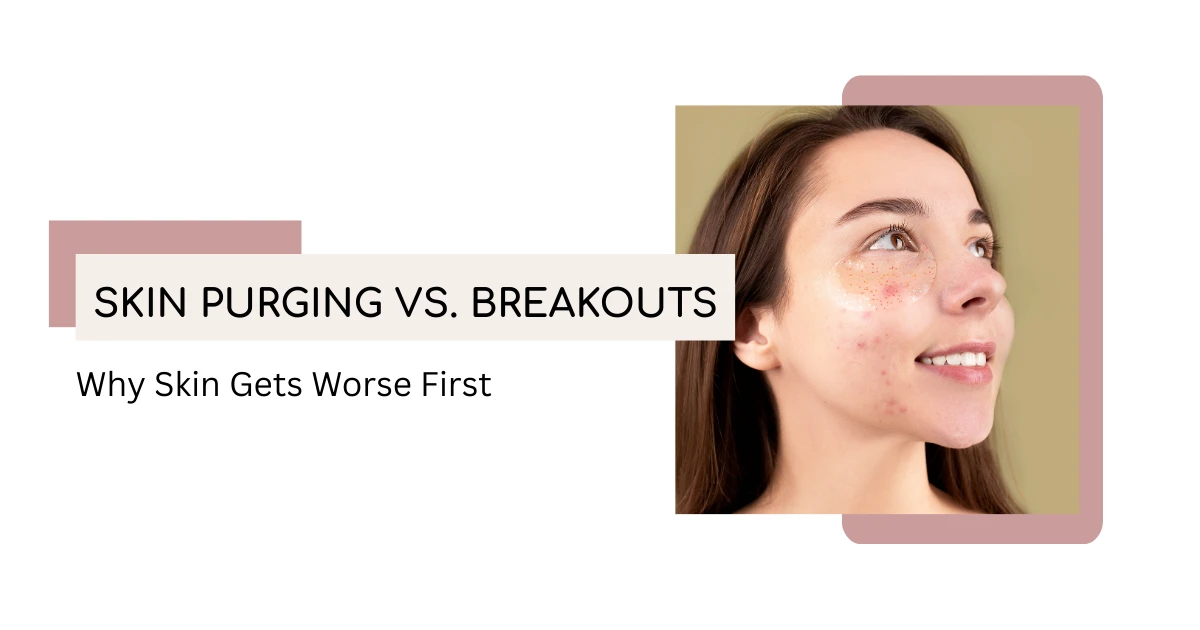

Last Updated: June 2026
KEY TAKEAWAYS
- Purging is caused by retinoids, AHAs, and BHAs — moisturisers and cleansers cannot cause it.
- Purging appears in your usual breakout spots. New areas mean it’s a reaction, not adjustment.
- Purging clears within 2–6 weeks. No improvement after 8 weeks — stop the product.
- Burning, stinging, or rash-like bumps mean stop immediately. That’s barrier damage, not purging.
- Three scenarios exist — purging, breakout, and irritation. Knowing which one changes everything..
- Reduce frequency before quitting — twice a week beats stopping entirely.
- Niacinamide doesn’t cause true purging but can surface congestion temporarily. Give it time.
- Most routines fail because people quit too early, not because the products are wrong.
What is the difference between skin purging vs breakout?
Skin purging is caused by retinoids and acids (AHAs/BHAs) speeding up cell turnover — it appears in your usual breakout spots and clears within 2 to 6 weeks. A regular breakout appears in new areas, doesn’t improve on its own, and usually means a product doesn’t suit your skin.
You finally commit to a proper skincare routine — retinol, an AHA, maybe a vitamin C and within days your skin looks worse than before you started. More spots. More texture. Then you start questioning everything.
If that sounds familiar, you’re not alone. Every year, many people around the globe search for answers to exactly this: why does skin get worse after starting a new routine, and how long it actually takes for skin to improve?
Here’s the thing, what you’re seeing might not be a bad reaction at all. It might be your skin doing exactly what it’s supposed to do. But it could also be a sign to stop. The difference matters, and this guide will help you tell them apart.
What Is Skin Purging?
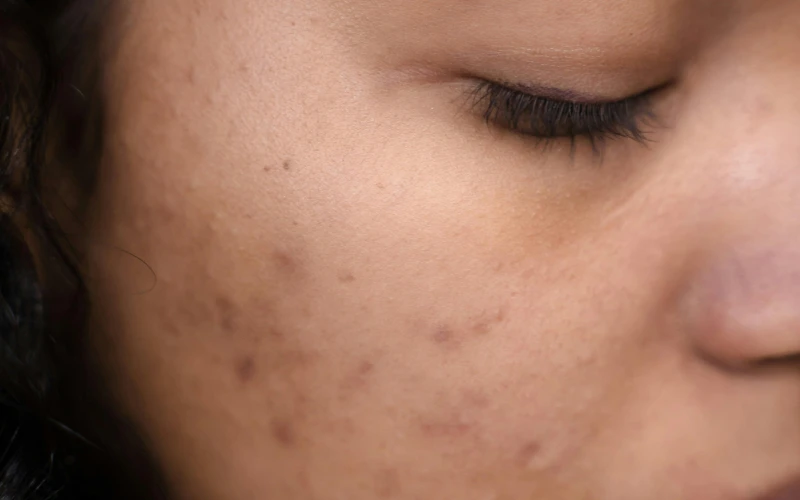
Skin purging happens when an active ingredient speeds up your skin’s natural cell turnover process. Normally, your skin sheds and renews itself roughly every 28 days. Certain ingredients fast-forward that cycle, and when they do, everything sitting deep inside your pores gets pushed to the surface much faster than usual.
Trapped sebum, congestion, clogged cells, all of it rises to the top at once. From the outside, it looks like a breakout. But it isn’t. It’s your skin clearing itself out.
Think of it like tidying a very messy room. Before it gets clean, it has to get messier first. That’s purging.
What Does Purging Actually Look Like?
Purging typically shows up as small whiteheads, blackheads, or tiny red bumps, usually surface-level and faster-healing than your typical pimple. They come to a head quickly and fade within days rather than weeks. Because the congestion was already forming beneath your skin before the active ingredient arrived, the spots tend to look familiar: the same kind you normally get, just more of them at once.
What purging doesn’t look like: painful, spreading cystic acne in places you’ve never broken out before. That’s the line between purging and a reaction, and it matters.
What Causes Skin Purging?
Not every new product can cause purging. Only ingredients that genuinely accelerate cell turnover are capable of triggering it. These are:
- Retinol and all retinoids — including adapalene and tretinoin
- AHAs — glycolic acid and lactic acid
- BHAs — salicylic acid
- Prescription acne treatments
Moisturisers, hydrating serums, gentle cleansers — none of these accelerate cell turnover. Vitamin C, antioxidants, and peptides also do not cause purging, despite what you may have read elsewhere. If you’re breaking out after introducing one of those, something else is going on and you should pay attention to it.
Professional treatments can also trigger purging. Microneedling, chemical peels, and medical-grade skincare routines all accelerate cell turnover in the same way active ingredients do, so if you’re seeing breakouts after a treatment, the same rules apply: check location, check timeline, and give it the same 2–6 week window before drawing conclusions.
As explained in the 30-day skincare routine results, early breakouts can be part of the skin’s adjustment phase. In that case, jawline spots appeared in week two after starting niacinamide, understanding what was happening made it easier to keep going. By day fourteen, skin had settled completely.
One note worth making: while dermatologists widely observe and describe the purging pattern, formal clinical trials specifically on “skin purging” as a defined phenomenon are limited. The mechanism is well-supported by what we know about cell turnover and active ingredients, but it’s worth knowing the evidence sits more in clinical observation than randomised controlled trials.
That doesn’t make the pattern less real, it just means you should be sceptical of anyone who makes it sound like a perfectly predictable science.
What Is a Breakout (and Why It Happens)?
A regular breakout has nothing to do with your skin adjusting to anything. It happens when pores get clogged or inflamed, from excess oil, hormonal shifts, stress, or a product that simply doesn’t go well with your skin. If your breakouts keep coming back despite a solid routine, the cause is often something outside your products entirely, pillowcases, phone screens, or maybe pore-clogging ingredients in your SPF. I went through this and wrote about why you’re still breaking out with a consistent skincare routine, it covers exactly what to check.
Unlike purging, breakouts don’t follow a pattern. They don’t improve week by week. They can appear in places you don’t normally get spots. And they tend to stick around or get worse the longer you keep using the product.
Put simply: purging is your skin telling you something is working. A breakout is your skin telling you something is wrong.
Skin Purging vs Breakout — Key Differences
Here’s a quick side-by-side comparison to help you spot the difference:
| Factor | Skin Purging | Regular Breakout |
| What triggers it | Retinoids, AHAs, BHAs | Clogged pores, hormones, wrong products |
| Where it appears | Your usual breakout areas | New areas of your face |
| How long it lasts | 2 to 6 weeks | Ongoing, no clear end |
| How it progresses | Gets better week by week | Stays the same or worsens |
| What to do | Continue at reduced frequency | Stop the product |
The two questions that matter most: Is it appearing in areas where you normally get spots? Did you recently start a retinoid or acid? If the answer to both is yes, then it’s very likely purging.
How Long Does Skin Purging Last?
Purging follows your skin’s natural cell renewal cycle. Since that cycle runs roughly 28 days, purging typically lasts anywhere from two to six weeks.
Eight weeks is the outer limit. A 2016 study in the British Journal of Dermatology found that participants using topical retinoids saw peak breakouts between weeks two and four, with clear improvement from week six onward for those who continued. The participants who stopped at week two never reached the improvement phase.
That’s worth remembering next time you’re tempted to quit.
Purging vs Reaction : The Difference Most People Miss
There’s a third scenario that often gets confused with purging ,and this one actually means you should stop straight away.
Irritation and barrier damage look quite different from purging. Where purging causes spots in familiar areas that gradually clear, irritation shows up as:
- Stinging or burning when you apply the product
- Peeling that feels painful, not just flaky
- Red, inflamed patches
- Rash-like bumps that don’t look like typical spots
- Tight, uncomfortable, raw-feeling skin
This is not your skin adjusting. This is your skin barrier breaking down and it needs immediate help. The moment you notice these signs, stop all active ingredients. Focus on repair, go back to basics with a gentle cleanser, a ceramide-rich moisturizer, and SPF, until your skin feels calm again. Then reintroduce slowly, if at all. If you are not sure what basics look like, you can read Minimum Skincare Routine for Beginners With Just 3 Products for details.
How to Tell If It’s Purging, Breakouts or a Bad Reaction
Go through these questions honestly. Most of the time, the answers will point you clearly in one direction.
| Questions | Purging | Breakouts | Reaction |
| Did you recently start retinol, an AHA, or a BHA? | ✅ | ||
| Are spots appearing in your usual breakout areas? | ✅ | ||
| Are spots appearing in new areas with no improvement after 4 weeks? | ✅ | ||
| Do you have burning, stinging, or a rash? | ✅ |
What To Do If You’re Not Sure
If you’re genuinely not sure about whether what you’re experiencing is purging or a reaction, the safest approach is to slow down — not stop entirely.
- Pause your active for 3 to 5 days and see how your skin responds
- Reintroduce it at a lower frequency — once or twice a week instead of daily
- Track where the spots are appearing and how they’re changing over time
- Simplify everything else — one active, a basic moisturizer, and SPF
Sometimes a step back is what lets you move forward.
How to Support Your Skin During Purging
You can’t fast-track purging, but you can make the process easier on your skin. Here’s what actually helps:
- Keep your cleanser gentle. Avoid anything stripping or foaming heavily while your barrier is under stress from an active.
- Moisturise more, not less. Pair your active with a ceramide-rich or barrier-repair moisturiser. Hydrated skin handles turnover better.
- Don’t pile on other actives. Limit exfoliants, masks, and additional acids during purging. One active at a time.
- SPF is non-negotiable. Your skin is more vulnerable to sun damage during accelerated turnover. Use it daily.
- Don’t pick. Purging spots clear faster than regular acne. Picking prolongs them and risks scarring.
Ingredients that help during purging: ceramides, glycerin, niacinamide at low percentages (2–5%), panthenol, and hyaluronic acid. These calm and repair without interfering with what your active is doing.
When To Stop a Product Immediately
Patience has real limits. Stop using a product straight away if you notice any of the following:
- Cystic, painful acne in areas where you’ve never broken out before
- Burning or stinging that doesn’t settle within a couple of days
- Swelling, hives, or a rash-like reaction
- Zero improvement after eight full weeks of consistent use
A 2021 review in the Journal of the American Academy of Dermatology found that early visible worsening is the single most common reason people abandon treatments that were actually working. Most active ingredients need 8 to 12 weeks for visible results. Stopping at week three means you’ll never know what might have happened.
Frequently Asked Questions
Does skin purging mean the product is working?
Yes, in most cases, purging is a sign that an active ingredient is accelerating cell turnover and clearing congestion that was already sitting beneath the surface. If spots are appearing in your usual breakout areas and gradually improving within six weeks, the product is doing its job. The key word is gradually, purging gets better week by week, it doesn’t stay the same or spread.
Can niacinamide cause purging?
Niacinamide does not cause true purging because it doesn’t accelerate cell turnover. What’s sometimes labelled a “niacinamide purge” is more often individual sensitivity to the formulation, or congestion surfacing as the skin’s barrier function improves, not the same mechanism as retinoid-driven purging at all. Give it two to three weeks, if things are calming down rather than spreading, it’s adjustment, not a reaction
How long does skin purging last?
Skin purging typically lasts two to six weeks, with eight weeks being the absolute outer limit. If your skin shows no improvement at all after eight weeks of consistent use, the product is likely not right for your skin, that timeline is long enough to tell the difference between purging and a genuine bad reaction.
How do I tell if it’s purging or a breakout?
Ask yourself two questions: are spots appearing where you normally break out, and did you recently start a retinoid or acid? If yes to both, it’s most likely purging. If spots are appearing in new areas, not improving after four weeks, or coming with pain or irritation, that’s a reaction, not an adjustment, and the product should be stopped.
Should I stop retinol if I’m breaking out?
Reduce frequently not immediately. If it’s been under six weeks and spots are mild and in your usual areas, cut back to twice a week and continue. If spots are severe, spreading to new areas, or accompanied by burning or stinging, pause completely, focus on barrier repair, and reintroduce slowly if you decide to try again.
Can moisturisers cause purging?
No, moisturisers cannot cause purging because they don’t accelerate cell turnover. If you’re breaking out after introducing a new moisturiser, check the ingredient list for pore-clogging ingredients like coconut oil, isopropyl myristate, or certain heavy silicones. That’s a compatibility issue, not purging.
Is purging the same as an allergic reaction?
No, purging and allergic reactions look and behave very differently. An allergic reaction causes redness, itching, or swelling, usually within hours of applying a product. Purging causes gradual spots in familiar areas that slowly improve over weeks. If you experience any swelling, hives, or burning that doesn’t settle quickly, stop the product and consult a dermatologist.
Can vitamin C cause purging?
No. Vitamin C is an antioxidant, not a cell-turnover accelerator, so it cannot cause true purging. If you’re breaking out after starting a vitamin C serum, it’s more likely a reaction to the formula, many vitamin C serums are acidic and can irritate sensitive skin. Try a lower percentage or a different form of vitamin C (like ascorbyl glucoside) rather than waiting it out.
Can purging happen after a facial or professional treatment?
Yes. Treatments like chemical peels, microneedling, and medical-grade facials all accelerate cell turnover the same way actives do. Post-treatment breakouts in your usual acne-prone areas that clear within 2–6 weeks are most likely purging. Breakouts in new areas, or skin that’s getting progressively worse rather than better, are worth flagging with your practitioner.
The Bottom Line
Understanding skin purging vs breakout is what stops you from quitting too early. Most skincare routines don’t fail because the products are wrong, they fail because people stop before the products have had time to work.
Once you can tell purging from a breakout from genuine irritation, the confusion disappears. You stop reacting to every spot and start understanding what your skin is actually telling you.
Purging is temporary. A breakout is a signal. Irritation is a stop sign. Know the difference — and your skincare decisions become a whole lot clearer.
Related Articles
- 30-day skincare routine results — what actually happens in the first month
- Minimum Skincare Routine for Beginners With Just 3 Products — the exact three products to start with before adding any actives
- How Long Does Skincare Take to Work– If you re wondering how long does different skincare products & ingredients take to work, you can check it here
- why you’re still breaking out with a consistent skincare routine– check here causes
Sources
- British Journal of Dermatology (2016) — Study on topical retinoid use and early breakout patterns
- Journal of the American Academy of Dermatology (2021) — Review on acne treatment adherence and early visible worsening
About the Author
Hi, I’m Sidra.
I’m not a dermatologist or any kind of skincare pro, I’m just someone like you, who got sick of constantly switching up products and never having a clue what was really working. After years of trial and error, I decided to focus on one thing: consistency.
I test routines on myself, I track results in detail, and I write about what realistically shifts and what doesn’t. My aim is to dispel hype and discuss skin-care the way I would with a friend: practical, honest, and backed by patience instead of promises.
Skin type: Normal to dry skin with mild sensitivity
The information in this article is for educational purposes only and does not replace professional dermatological advice. If you have a specific skin condition or concern, please speak with a qualified healthcare provider.