

KEY TAKEAWAYS
- Cakey makeup usually comes from an unabsorbed moisturiser sitting on the skin’s surface, not a bad foundation
- Wait 10 to 15 minutes after a cream moisturiser before applying base makeup. A gel needs less; a rich cream needs more
- Silicone-based primers and water-based foundations can physically repel each other and pill within minutes
- More skincare is not the fix. Layering several good products at once creates the same texture problem as using too little
- Skin can look dewy and still be dehydrated underneath. Looking moisturised and being well-hydrated are not the same thing
- Hyaluronic acid without a sealant in a dry room can leave a tacky surface that grabs foundation unevenly
- Skin tints lower cakey-makeup risk because there’s less product mass on the skin, not because they’re magic
Why does my makeup look cakey even with good skincare?
Cakey makeup with good skincare almost always comes down to timing and product mismatch, not foundation quality. Moisturiser that hasn’t fully absorbed creates a slip layer that foundation grabs onto unevenly. Silicone and water-based products can repel each other. And too much good skincare layered at once leaves a surface foundation simply can’t sit on smoothly.
My skin has never looked better since I started taking my skincare seriously. My makeup, on the other hand, started looking worse.
For months I blamed my foundation. I switched formulas three times before I noticed the pattern: cakey makeup only showed up on mornings when I’d finished a longer skincare routine. Same foundation, same brush, completely different result depending on what I’d put on ten minutes earlier.
The beauty industry tells you to buy a better primer. Nobody tells you your moisturiser might still be sitting on your skin, unabsorbed, when you start applying base.
This article covers the skin-prep side of cakey makeup, everything that happens in the ten minutes before you pick up your foundation.
Why Moisturiser That Hasn’t Absorbed Yet Causes Cakey Makeup
Moisturiser doesn’t sink the moment it touches your skin. For the first several minutes it sits on the surface as a thin, semi-liquid layer while your skin’s outer layer, the stratum corneum, slowly takes up the water and other ingredients.
Foundation applied during that window doesn’t sit on skin. It sits on a half-absorbed product. Pigment particles bind unevenly to that liquid film instead of to your skin directly, building up in fine lines and around the nose. That buildup is what reads as cakey.
How long to actually wait
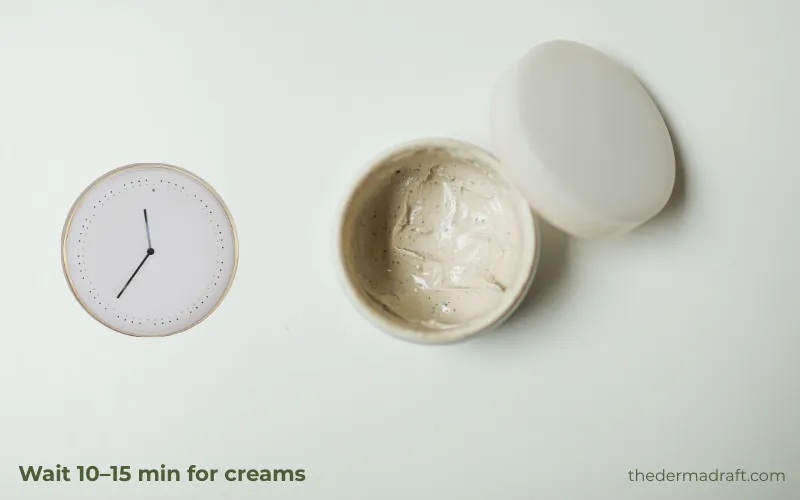
The wait time depends on the formula. A lightweight gel moisturiser needs 3 to 5 minutes. A standard lotion needs 5 to 8 minutes. A rich cream can need 10 to 15 minutes before it’s genuinely absorbed rather than just looking absorbed.
I tested this on myself for a week, applying foundation at different intervals after the same moisturiser. In 2 minutes it looked patchy by midday. For 12 minutes, it was held all day. Same product. Only the clock changed.
What’s happening on your skin’s surface
A study on stratum corneum hydration found that as the outer skin layer takes up water, its surface profile becomes measurably smoother. A fully absorbed, hydrated surface is genuinely flatter and easier for the foundation to sit on evenly.
The smoothing benefit only kicks in once the water has settled into the skin, not while it’s still pooling on top.
Silicone vs Water-Based Skincare: Why Your Base Layers Fight Each Other
Silicones such as dimethicone form a smooth, breathable film across the skin’s surface. Water-based products work differently, drawing moisture into the skin rather than sitting on top of it.
Put a silicone film over a water-based layer that hasn’t fully set, and the two don’t blend. They slide against each other. Within minutes you get small balls of product rolling under your fingers, the textbook definition of pilling.
A 2021 review of cosmetic surface science describes this as a substrate compatibility problem between formulations, not a flaw in any single product.
How to spot which type you’re using
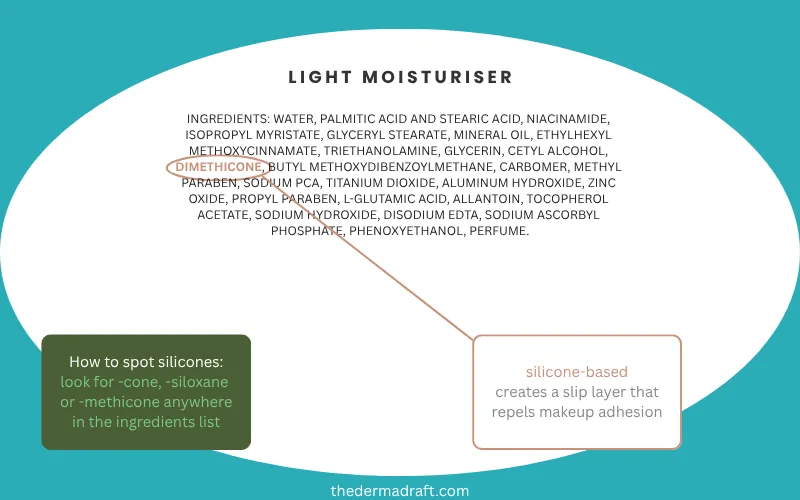
Check the ingredient list, not the marketing on the bottle. Dimethicone, cyclopentasiloxane, or cyclohexasiloxane near the top means silicone-based. Glycerin, hyaluronic acid, or water listed first means water-based.
| Moisturiser Base | Foundation Base | What Happens | Fix |
| Silicone moisturiser | Silicone foundation | Glides smoothly, blends well | No change needed |
| Silicone moisturiser | Water-based foundation | Foundation can slide or separate | Let moisturiser fully set, or switch one product |
| Water-based moisturiser | Silicone foundation | Can pill within minutes | Wait longer, or add a water-based primer first |
| Water-based moisturiser | Water-based foundation | Blends well once absorbed | Just wait for full absorption |
Why Too Much Good Skincare Creates the Same Problem as Too Little
A serum, an essence, an eye cream, two moisturisers, a facial oil, then SPF, each one individually excellent, can still add up to more product than your skin can absorb before makeup goes on. The result looks identical to under-prepping.
If your skin is calm and well-managed, the only minimal skincare routine beginners actually need is worth revisiting, not because your products are wrong, but because on makeup mornings fewer steps done well beats every step you own stacked one after another.
On days I’m wearing makeup, I cut back to three steps: cleanser, one hydrating serum, one moisturiser. Everything else moves to my night routine, where it has the whole night to do its job.
The Difference Between Skin That Looks Moisturised and Skin That’s Actually Hydrated
Dewy, plump-looking skin right after applying skincare isn’t proof your skin is well-hydrated. It can simply mean a humectant ingredient is pulling water to the surface and creating a temporary sheen.
Hyaluronic acid draws water toward itself. In a humid bathroom that water comes from the air. In a dry or air-conditioned room there’s nothing in the air to grab, so it pulls water up from the deeper layers of your own skin instead (Dermato-Endocrinology, 2012).
Foundation applied during that window sits on a surface that’s temporarily moist on top and slightly under-hydrated below, a mismatch that shows up later as a tacky T-zone with dry patches everywhere else. The full mechanism, including how to use hyaluronic acid so it seals instead of backfiring, is covered in our complete guide to niacinamide, hyaluronic acid, and retinol.
The fix: apply your humectant to skin still slightly damp from cleansing, then seal it immediately with a moisturiser that contains an occlusive. Give that combination its full absorption time before makeup.
A Timed Morning Routine Sequence for Smooth Makeup Application
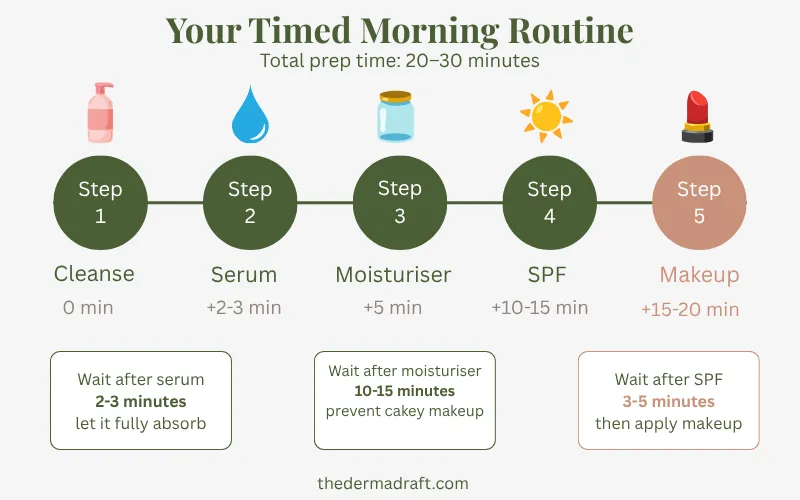
This sequence keeps every step in the right order with timing built in so you’re not guessing.
Cleanse: Skin should feel neutral afterward, not tight or stripped. A stripped barrier absorbs everything that follows unevenly. If your skin reacts to most cleansers, our guide on cleanser causing skin redness covers exactly why.
Lightweight hydrating serum: Apply to slightly damp skin. Wait 2 minutes.
Moisturiser: Wait 10 to 15 minutes for a cream formula, less for a gel. This is the step most people rush, and the one that matters most.
SPF: Wait 3 to 5 minutes before makeup. Rushing SPF is one of the most common causes of a chalky, separated finish under foundation.
Makeup: Skin should feel comfortable, not tacky and not slick, before you start.
This timing follows the same protect-versus-repair logic that governs your whole morning. For the full breakdown of what belongs in AM versus PM and why, see our guide on morning skincare vs night skincare.
Skincare Ingredients That Quietly Conflict With Makeup Adhesion
A handful of ingredients cause foundation problems often enough to call out specifically.
- Heavy occlusives in thick concentration: Petrolatum and dense dimethicone blends sit on the surface longer than lighter formulas. Great at night, less ideal right before makeup without extra absorption time.
- Exfoliating acids the same morning: AHAs and BHAs increase how easily skin flakes in the hours after application. Foundation grabs onto that flaking unevenly. These belong at night anyway, both for this reason and for sun sensitivity.
- Excess glycerin in humid climates: In already-humid air, a glycerin-heavy formula can stay tacky longer than expected, giving the foundation something to grip unevenly rather than glide across.
None of these ingredients are wrong for your skin. The issue is almost always timing, not the ingredient itself.
Skin Tints and the Skinification Trend: Do They Actually Fix Cakey Makeup?
A lot of beauty coverage in 2026 points to the same shift: serum-textured skin tints replacing full-coverage foundation. ILIA’s Super Serum Skin Tint, launched in 2020 with SPF 40 and a formula built around hyaluronic acid, niacinamide, and squalane, helped popularise the category. The brand was acquired by a larger beauty group in 2022, a sign of how quickly the format went mainstream.
Not a recommendation to buy it. A useful, factual example of how the trend works in practice.
The honest mechanism: skin tints tend to look less cakey because there’s simply less total product on the skin. Every problem covered in this article, unabsorbed moisturiser, base mismatches, over-layering, still applies. There’s just less surface area for those problems to show up visibly.
A skin tint over wet, unabsorbed moisturiser will still look patchy. It’s not a shortcut around skin prep. It’s a smaller margin for error. If your prep is already solid, switching formats is optional. If it isn’t, a lighter product hides the gap for slightly longer, not permanently.
Frequently Asked Questions
Why does my makeup look cakey even with good skincare?
Almost always timing. Moisturiser that hasn’t fully absorbed creates a liquid layer foundation grips unevenly. Mismatched silicone and water-based formulas repel each other. Layering too many products leaves more on the surface than your skin can take up before makeup goes on.
How long should I wait after moisturiser before applying foundation?
For a gel, 3 to 5 minutes. For a lotion, 5 to 8 minutes. For a rich cream, 10 to 15 minutes. Skin should feel comfortable, not tacky and not slick, before you start.
Can a silicone primer cause my foundation to pill?
Yes, if layered with a water-based product that hasn’t fully set. Silicone forms a film on the surface, and a water-based layer still absorbing underneath slides against it rather than bonding. That shows up as small rolling balls of product within minutes.
Why does my foundation look dry and patchy instead of cakey?
Dry, patchy texture usually means dehydration. Hyaluronic acid applied without a moisturiser to seal it in, especially in dry or air-conditioned rooms, can leave the surface under-hydrated by the time makeup goes on.
Can using too much skincare make my makeup look worse?
Yes. Stacking several hydrating or active products in one morning can leave more product on the surface than skin can absorb in time. The fix isn’t using worse products, it’s using fewer of them on makeup days.
Do skin tints actually fix cakey makeup?
Not directly. They lower the risk because there’s less total product on skin to begin with, which leaves less room for absorption or base-mismatch problems to show up visibly. The same prep rules still apply underneath.
Which skincare ingredients should I avoid right before applying makeup?
Exfoliating acids, retinol, and heavy occlusive creams are the main ones. Each can leave skin more textured or slower to fully absorb in the hours that follow. Apply them the night before on makeup days.
Why does my makeup look cakey in winter but fine in summer?
Lower humidity in winter, plus indoor heating, speeds up moisture loss from skin and from humectant ingredients like hyaluronic acid. Skin often needs a richer moisturiser and a longer absorption wait during colder months.
Bottom Line
Cakey makeup almost never starts with your foundation. It starts ten minutes earlier, with whatever went on your skin and how much time it had to absorb. Wait for full absorption, match your bases, and cut back on products on makeup mornings.
As skin tints and serum-foundation hybrids become more common, the absorption timing rule isn’t going away. Lighter formulas show every bit of unevenness a heavier foundation used to cover up.
Related Articles
- Morning vs night skincare routine — why timing your skincare sequence directly affects how makeup sits on your skin
- Cleanser causing skin redness — how a stripped barrier changes the way everything you apply afterward behaves
- Niacinamide, hyaluronic acid and retinol — what each one actually does, including the hyaluronic acid mistake that leaves skin tacky before makeup
Sources
- International Journal of Cosmetic Science (1986): Hydration of the stratum corneum
- Advances in Colloid and Interface Science (2021): Surface science of cosmetic substrates, cleansing actives and formulations
- Dermato-Endocrinology (2012): Hyaluronic acid: A key molecule in skin ageing
About the Author
Hi, I’m Sidra.
I’m not a dermatologist or any kind of skincare pro, I’m just someone like you, who got sick of constantly switching up products and never having a clue what was really working. After years of trial and error, I decided to focus on one thing: consistency.
I test routines on myself, I track results in detail, and I write about what realistically shifts and what doesn’t. My aim is to dispel hype and discuss skin-care the way I would with a friend: practical, honest, and backed by patience instead of promises.
Skin type: Normal to dry skin with mild sensitivity
The information in this article is for educational purposes only and does not replace professional dermatological advice. If you have a specific skin condition or concern, please speak with a qualified healthcare provider.