

Last Updated: June 2026
KEY TAKEAWAYS
- Three products are all you need to start — a gentle cleanser, a moisturiser (with ceramides or hyaluronic acid), and broad-spectrum SPF 30+. Everything else is optional
- UV causes up to 90% of visible skin ageing — making SPF the single most impactful product in any routine, not serums or actives.
- Price doesn’t equal results — consistency with basic, affordable formulations is what peer-reviewed research actually supports
- Wait at least 4 weeks before adding anything new — your skin renews every ~28 days, so reactions (good or bad) only become clear after one full cycle.
- Introduce products one at a time — adding multiple products together makes it impossible to identify what’s helping or hurting.
- Oily skin still needs moisturiser — skipping it causes the skin to overproduce oil in compensation.
- When things go wrong, go back to three — strip down, let skin settle for two weeks, then reintroduce one product at a time
What is the minimal skincare routine for beginners?
A minimal skincare routine for beginners needs only three products: a gentle cleanser, a moisturiser with ceramides or hyaluronic acid, and a broad-spectrum SPF 30 or higher. which must be used consistently everyday.
We think most of the wrinkles, dark spots, loss of firmness in skin comes from stress or diet but up to 90% of these signs of skin ageing are due to UV radiations from sunlight. Still the skincare industry will sell you many other products before it gets to that fact.
If you’re new to skincare, the variety can feel overwhelming. On any random TikTok video, you see fifteen products lined up on someone’s shelf, serums, toners, essences, oils, masks. Looking at your bathroom, you might feel like you’re already behind.
You’re not. You might be where you should be.
A minimum skincare routine for beginners isn’t a compromise. It’s the right way to start. The one most dermatologists actually recommend.
This article focuses on just three products: why these three, how to select them without overspending, and the signs that indicate your skin is ready to add something new. If you’re searching for a minimum skincare routine as a beginner, you’re in the right place.
Why Most Beginner Guides Are Wrong About How Much You Need
Let me tell you one thing before you buy anything: The skincare industry makes money when you buy products. Most blogs, channels and even some apps are funded by affiliate links or brand partnerships.
This isn’t a conspiracy theory. It’s just how the business works.
I don’t think you need 14 steps to have beautiful skin. You only need three steps: a good cleanser, a good moisturizer, and of course, a sunscreen.
The Cleveland Clinic agrees. Their published guidance states that at a minimum morning routine needs a cleanser, a moisturiser and sunscreen, in that order. Nothing else is needed to get started.
I learned this firsthand. In my 30-day skincare routine results, I began with three products and added more slowly over time. This pacing helped me understand what my skin really needed.
The 3 Products in a Minimal Skincare Routine for Beginners — And Why These Three
A Gentle Cleanser
Your skin collects sweat, oil, pollution and dead skin cells throughout the day. A cleanser removes that buildup. The best gentle cleanser for beginners is one that doesn’t strip your skin’s natural oils, so look for fragrance-free, sulfate-free, or non-foaming on the label. If your skin turns red after washing, cleanser causing skin redness explains exactly why that happens and how to pick the right formula.
Cleanse your face twice a day. At night, it removes SPF and the day’s buildup. In the morning, it clears whatever your skin produces overnight.
Quick Check: Is Your Cleanser Too Harsh?
If any of these happen after washing, your cleanser is too stripping:
- Your face feels tight or “squeaky clean” within 2 minutes of rinsing
- Redness appears within 5 minutes of washing
- Your skin stings when you apply moisturiser right after
Switch to a non-foaming, fragrance-free formula and retest for one week.
A Moisturiser
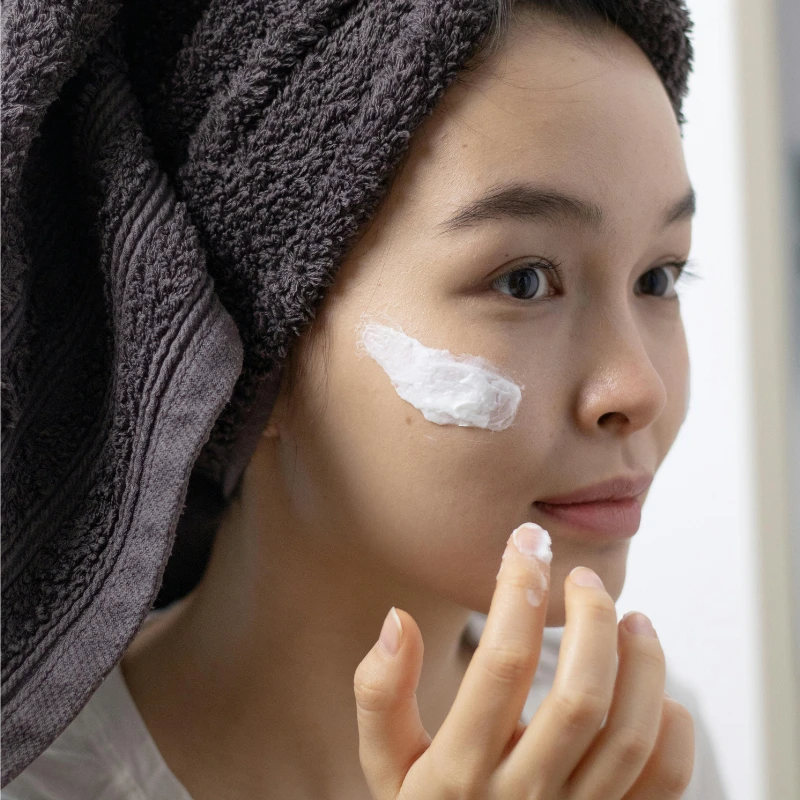
Your skin barrier is the outermost layer of skin. A moisturiser supports that barrier. Look for ceramides or hyaluronic acid in the ingredients. Ceramides help rebuild the barrier, while hyaluronic acid helps retain moisture.
If you want to know exactly what hyaluronic acid is doing inside your skin and how to apply it correctly, the full breakdown is in our ingredient guide to niacinamide, hyaluronic acid, and retinol.
Apply it while your skin is still slightly damp after cleansing. This improves absorption and effectiveness.
Oily skin also needs a moisturiser. When skin is dehydrated, it produces more oil to compensate. Skipping moisturiser can actually make oiliness worse, not better.
SPF 30 or Higher — Every Single Morning
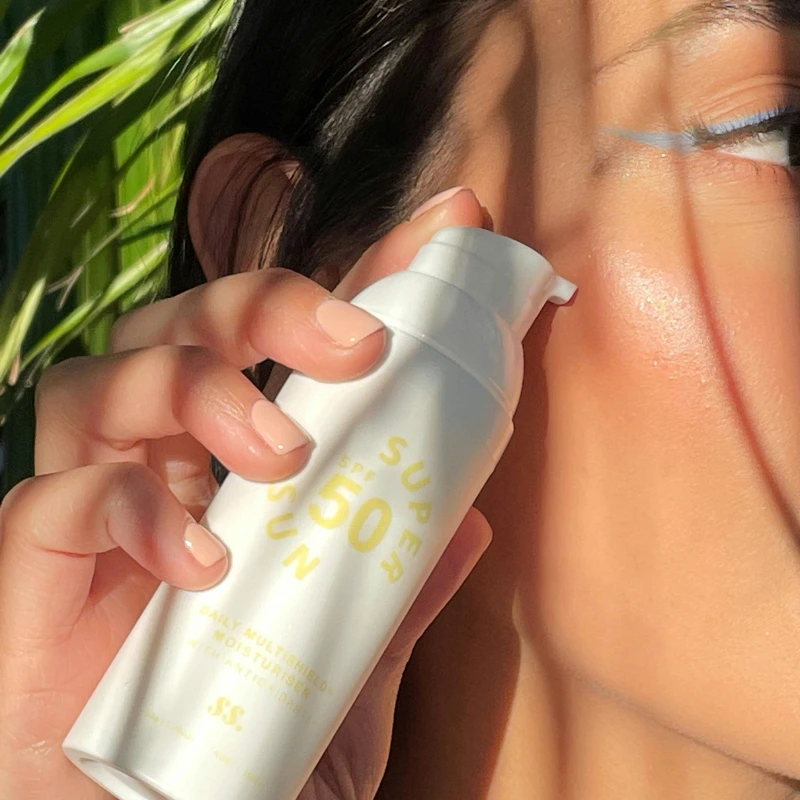
Ultraviolet radiation is responsible for up to 90% of visible skin ageing, including wrinkles, dark spots, and loss of firmness (Skin Cancer Foundation).
SPF is the most effective anti-ageing product that exists. Choose a broad-spectrum SPF 30 or higher and apply it after moisturiser every morning regardless of the weather.
SPF 30 applied every single day will always outperform SPF 50 applied occasionally. Consistency matters more than the number on the bottle.
If you live in a high-UV country like Australia or South Africa, SPF 50 is better for daily outdoor use.
Mineral vs. Chemical SPF: Which Should You Pick?
This is one of the most common beginner questions, and the answer is simpler than most guides make it.
| Mineral SPF | Chemical SPF | |
| How it works | Sits on skin, reflects UV | Absorbs into skin, converts UV to heat |
| Finish | Can leave white cast | Usually invisible / lightweight |
| Best for | Dry, sensitive, reactive skin | Oily, acne-prone, darker skin tones |
| Feel | Thicker texture | Lighter, more wearable |
| Reef-safe | Yes (zinc oxide) | Most are not |
The best SPF is the one you’ll actually use every day. If white cast bothers you, go chemical. If your skin reacts easily, go mineral. Both protect equally well when applied correctly.
Not sure why SPF is only a morning step? Morning Skincare vs Night Skincare Routine explains the full reasoning.
Which of These 3 Products to Pick Based on Your Skin Type
The 3-product framework is universal. But the specific formulas within each category vary by skin type. Here’s how to pick without guesswork.
| Skin Type | Cleanser to look for | Moisturiser to look for |
| Oily / Acne-prone | Gel or foaming, salicylic acid optional | Lightweight, oil-free, non-comedogenic |
| Dry / Tight | Cream or milk cleanser, no sulfates | Rich cream with ceramides + hyaluronic acid |
| Combination | Gentle gel, fragrance-free | Lightweight lotion, not too heavy |
| Sensitive / Reactive | Cream cleanser, minimal ingredients | Fragrance-free, no essential oils, with oat or ceramides |
| Normal | Any gentle, fragrance-free formula | Any light moisturiser with ceramides or HA |
For SPF: all skin types need broad-spectrum SPF 30+. Oily skin tends to prefer lightweight chemical formulas; dry or sensitive skin often does better with a mineral option. If you’re unsure, try mineral first — it’s less likely to cause a reaction on an unfamiliar routine.
Not sure what skin type you are? Cleanse your face with nothing else, wait 30 minutes, and observe: shine all over = oily; tightness = dry; shine only on forehead/nose/chin = combination; stinging or redness = sensitive.
How to Choose Budget-Friendly Skincare Products as a Beginner
Most people assume they need to spend more to get results. But that’s not how it works.
A consistent daily skincare routine using a gentle cleanser and moisturiser has been shown to measurably improve skin hydration and reduce dryness in peer-reviewed clinical trials (Kim et al., Journal of Dermatologic Treatment, 2021). The results came from consistency with basic formulations, not from premium pricing.
Below I’ve mentioned, what really matters at each price point:
| Products | What to look for | What doesn’t matter |
| Cleanser | Fragrance-free, sulfate-free, gentle formula | Fancy packaging, added actives |
| Moistiriser | Ceramides or hyaluronic acid in the ingredient list | Brand name, jar size, marketing claims |
| SPF | Broad-spectrum, SPF 30 minimum, sits well on your skin | Price — FDA regulates SPF labelling so cheaper works the same |
For the cleanser, especially, keep in mind that you are washing it down the drain. There’s no benefit to spending more. For moisturizer and SPF, find a texture you enjoy using. If it feels unpleasant, you may skip it.
Ingredients to avoid as a beginner: fragrances, essential oils, alcohol denat (drying), and anything labelled “exfoliating” in a daily product. These are common irritants that can disrupt a skin barrier that is still adjusting. For a full breakdown of cleanser ingredients that trigger redness, why every cleanser irritates your skin covers each one clearly.
How Long to Stay at 3 Products and When to Expand Your Skincare Routine
This is the part many beginner guides forget. They tell you to start simple but don’t mention when it’s actually safe to add more.
Most people don’t wait long enough, and that’s when things go wrong.
Your skin needs a minimum of four weeks to adjust to any new product because it renews itself about every 28 days. Any reaction, whether it’s good or bad—only becomes clear after that cycle is complete.
Most skincare ingredients also require four to twelve weeks of consistent use before you see visible results. If you switch or add products too soon, you won’t know what worked.
So, wait a minimum of four weeks with just three products before considering anything new. Some skin types, particularly sensitive or reactive skin, might need six to eight weeks.
Think of it like giving a new employee a month before reviewing their performance. You wouldn’t judge them after three days. Your skin deserves the same patience.
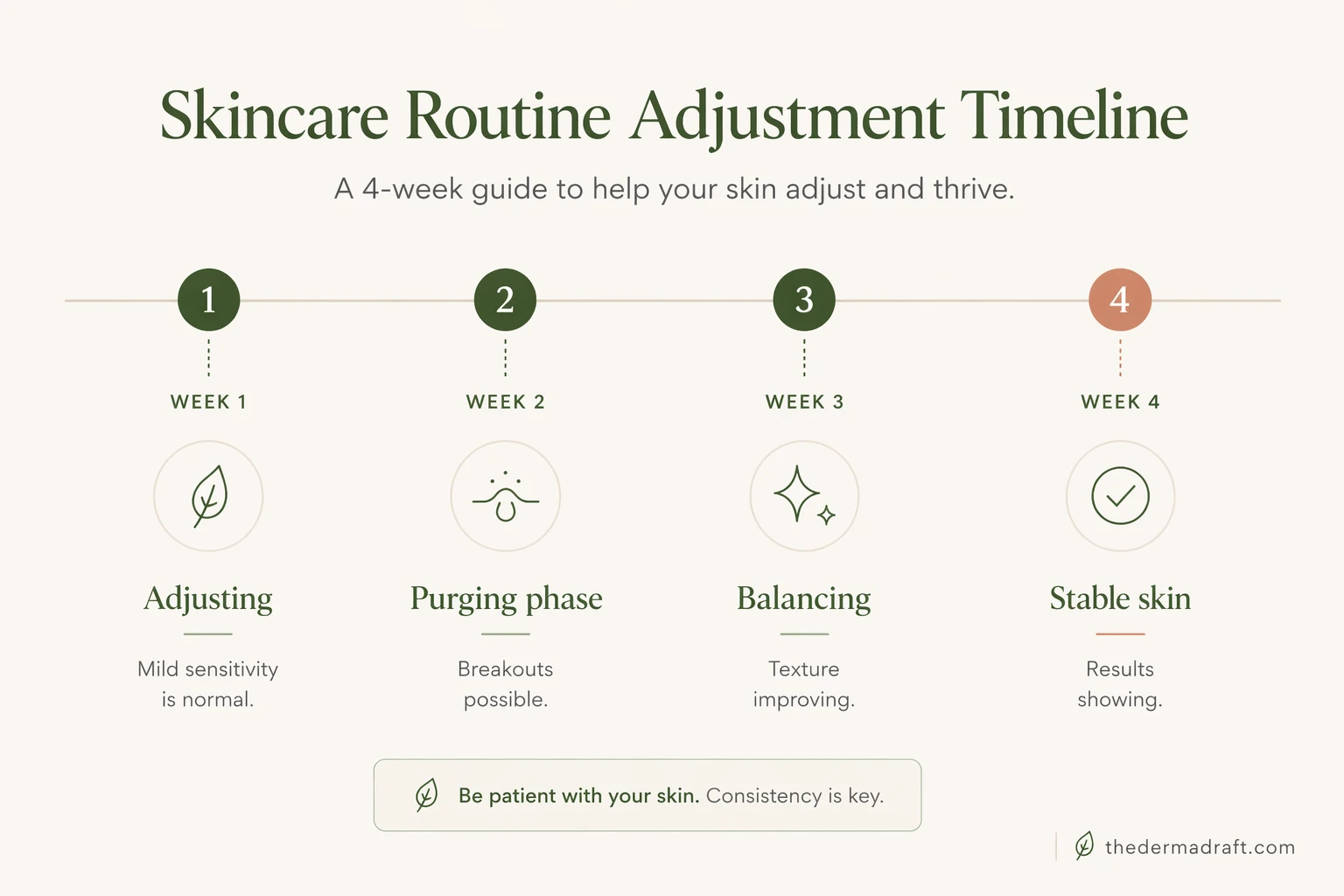
What skin adjustment actually looks like:
The first week often feels unremarkable. Nothing dramatic happens, and that’s completely normal. I face it too and it looks boring and frustrating. Around days four to seven, some people notice mild sensitivity, not painful, just reactive to temperature or wind. Don’t panic like I did, This is your skin’s barrier beginning to respond to gentler products.
By weeks two and three, things feel more settled. Skin is less reactive. Hydration starts to feel more consistent throughout the day.
By week four, if nothing is causing irritation, your barrier is stable. That’s the green light. If you want to understand what that adjustment phase really feels like day by day, the skin purging vs breakout guide covers the exact signs to watch for and how to tell normal adjustment from a genuine problem.
Signs your skin is ready to add something new:
- No irritation, redness, or breakouts from your current three products
- Skin feels comfortable and settled throughout the day
- You’ve been consistent, using all three products daily for at least four weeks
- You have specific reason to add something, not just because you’re bored
That last point matters more than people realise. Adding products without a clear goal is how routines get complicated and skin gets confused.
If you’re not sure which active to add first, the guide on which active ingredient beginners should start with explains the decision clearly.
Signs You’ve Added Too Much Too Soon
This experience happens to almost everyone at some point. You stay patient for four weeks, your skin looks great, and then you add two new products in the same week out of excitement. A week later, something is off, and you don’t know what caused it.
New breakouts after introducing a product are clear signs something is wrong. But if you’ve added multiple products at once, you can’t pinpoint the culprit. It’s an isolation problem. You can’t solve it without going back to the basics.
Changes in texture, unexpected dryness, or redness after adding something new generally indicate one of three issues: the product contains an irritant your skin can’t handle or you’ve overloaded your skin and disrupted your barrier or you’ve introduced an active ingredient too rapidly.
When something goes wrong, less is always the answer. Strip back to your three core products, give your skin two weeks, and start again — one product at a time.
How to reset if things go wrong:
- Stop everything except your three core products, Cleanser, moisturiser, SPF.
- Give your skin two weeks to settle.
- Add one product at a time.
If you’ve done this reset before and still can’t figure out what’s causing the problem, the full guide on what to do when your skincare routine isn’t working covers the complete elimination framework, including lifestyle triggers most routines never address.
Frequently Asked Questions
What are the 3 products in a minimal skincare routine for beginners?
A minimal skincare routine for beginners needs just three products: a gentle cleanser, a moisturiser with ceramides or hyaluronic acid, and a broad-spectrum SPF 30 or higher. That’s it, everything else is optional until your skin has fully adjusted to these three and you have a specific reason to add more.
Can a 3-step skincare routine be enough?
Yes. A 3-step routine covers every essential function your skin needs: cleansing to remove buildup, moisturising to support the barrier, and SPF to prevent UV damage. Most dermatologists actively recommend starting here rather than layering multiple active ingredients from the beginning.
When should beginners add serums to their skincare routine?
Not before four weeks of consistent use with your three core products. Once your skin is stable, no irritation, no unexpected breakouts, consistently comfortable throughout the day — you can consider adding one serum with a clear purpose (brightening, anti-ageing, acne). Introduce it alone, not alongside another new product.
Does a 3-product minimal skincare routine work for oily skin?
Yes, including the moisturiser step. Oily skin still needs hydration, skipping moisturiser causes the skin to produce more oil to compensate, making oiliness worse. Choose an oil-free, non-comedogenic formula with hyaluronic acid rather than a heavy cream.
What is a night routine with only 3 products?
Cleanser, then moisturiser, that’s it. No SPF needed while you sleep. For the full reasoning behind why morning and night routines differ, Morning vs Night Skincare Routine covers it in detail.
How do I know if a product is right for my skin type?
Patch test it on your inner arm for 24 hours before applying to your face. On your face, use it for at least two to four weeks before judging — skin needs time to adjust. Signs a product doesn’t suit you: persistent redness, stinging on application, new breakouts in unusual areas, or skin that feels tight after use.
What is skinimalism and is it the same as a minimal skincare routine?
Skinimalism is the 2026 term for intentional, simplified skincare, the idea that fewer products, used consistently, produce better long-term results than complex routines. A minimal skincare routine is exactly this in practice. Dermatologists have endorsed it not as a trend but because evidence shows that over-layering active ingredients often causes more irritation than it resolves.
Is mineral or chemical SPF better for beginners?
Either works. Mineral SPF (zinc oxide or titanium dioxide) is generally better tolerated by sensitive or reactive skin. Chemical SPF tends to be lighter and less visible, which makes it easier to wear daily on oily or darker skin tones. The best SPF is the one you’ll actually apply every morning, texture and finish matter more than the filter type for beginners.
The Bottom Line

The skincare industry wants people to believe that doing means caring more. It doesn’t.
Starting with three products, a gentle cleanser, a moisturiser, and SPF, is not cutting corners. It is what the science and most dermatologists actually support. It gives your skin a stable foundation and time to understand what your skin needs before adding more. This minimum skincare routine for beginners is a complete approach, not a starting point to rush past.
Stay at three products for at least four weeks. Add one thing at a time when you’re ready. If something goes wrong, go back to three.
The goal isn’t a full shelf. The goal is skin that works.
Once you’ve had a few weeks of consistency, the next step is understanding what happens when your skin starts adjusting and what to do when it doesn’t go smoothly. That’s what we covered in the 30-day skincare routine results, week by week.
Related Articles
- 30-day skincare routine results: what happens in the first month when you commit to a simple routine
- Skin purging vs breakout: how to tell the difference when your skin gets worse after starting something new
- Morning vs Night Skincare Routine: If you don’t know why morning & night skincare is different, click here
- Cleanser causing skin redness: How to know if your cleanser suits your skin & if it irritates then which ingredients to check in it
- Guide on Niacinamide, Hyaluronic acid & Retinol: Learn the Use & pros & cons of these three most talked ingredients
- How to build a skincare routine when nothing works — the complete reset and reintroduction framework for anyone who has already tried simplifying and still isn’t seeing results
Sources
- Skin Cancer Foundation — UV radiation and visible skin aging statistics
- Cleveland Clinic — Dermatologist-recommended skincare routine order
About the Author
Hi, I’m Sidra.
I’m not a dermatologist or any kind of skincare pro, I’m just someone like you, who got sick of constantly switching up products and never having a clue what was really working. After years of trial and error, I decided to focus on one thing: consistency.
I test routines on myself, I track results in detail, and I write about what realistically shifts and what doesn’t. My aim is to cut through the noise and talk about skincare the way I would with a friend: practical, honest, and backed by patience instead of promises.
Skin type: Normal to dry skin with mild sensitivity
The information in this article is for educational purposes only and does not replace professional dermatological advice. If you have a specific skin condition or concern, please speak with a qualified healthcare provider.