


KEY TAKEAWAYS
- Fragrance in skincare is not automatically bad. Most people tolerate it fine
- The real risk is fragrance sensitization, and it can build up even in skin that never reacted before
- Fragrance-free and unscented are not the same word. Unscented products can still contain masking chemicals
- New EU rules mean a longer, more honest ingredient list is coming to shelves by July 2026
- IFRA certification means an ingredient sits under a safety limit. It does not mean nobody reacts to it
- A simple 3-day test tells you if fragrance is really your problem before you blame a whole product line
Is fragrance in skincare actually bad for your skin?
Not necessarily. Fragrance in skincare is tolerated well by most people, but it can become a problem when it causes irritation or fragrance sensitization, especially in reactive or barrier-compromised skin. Sensitivity can develop even after years of using the same product without issues. Fragrance-free products are usually the safer choice for sensitive skin, while unscented products can still contain masking fragrance chemicals that may trigger reactions.
Open your bathroom cabinet and I would guess at least half of what is in there has fragrance in it. Somewhere between now and 2028, some of those labels are going to look very different, and that’s not from a formula change.
Fragrance in skincare has turned into one of those topics where everyone has a strong opinion and half of them are wrong. One camp, often quoting a single TikTok video instead of an actual patch test, says any fragrance is a slow disaster for your skin. The other says the fear is overblown and you are missing out on good products for nothing.
Neither camp is being straight with you. Fragrance is genuinely fine for most people, until it is not, and that switch can flip after years of zero problems.
I will walk you through what fragrance actually is on a label, why some skin reacts and some never does, a real case where good actives got buried under one bad scent decision, and the regulation changes, which are about to make your ingredient list longer.
What “Fragrance” Actually Means on a Label
“Fragrance” or “parfum” on an ingredient list is not one thing. It is a legal shortcut for a mix that can hold anywhere from a handful to over a hundred individual chemicals, and brands do not have to name them. That rule exists to protect a company’s exact scent formula from being copied. It was never about protecting your skin.
Fragrance comes from two sources. Natural fragrance means essential oils and plant extracts, things like lavender, citrus peel, or rose. Synthetic fragrance means lab-made scent molecules. Neither one is automatically the safer choice.
Some of the most common triggers, limonene and linalool, come from citrus and lavender oils, and they get more likely to cause a reaction once they have been sitting in a bottle and oxidizing in air.
That detail is the part most “natural is safer” articles skip. A fresh essential oil and one that has been oxidizing on a shelf for a year are not the same ingredient anymore. The label still says otherwise.
Who Should Be More Careful With Fragrance in Skincare?
Fragrance is not automatically harmful, but some skin types are much more likely to react to it over time.
You may want to prioritize fragrance-free skincare if you have:
- eczema-prone skin
- rosacea
- a damaged or over-exfoliated skin barrier
- active acne treatments or retinoid use
- known fragrance allergies or sensitivities
- recent chemical peels, lasers, or microneedling
- persistent redness, burning, or unexplained irritation
This does not mean every fragranced product will cause a reaction. It simply means your skin barrier is already under more stress, making fragrance sensitization more likely to develop.
The important part is that irritation risk is not the same for everyone, which is why one person can use heavily fragranced skincare for years while another reacts almost immediately.
Fragrance-Free vs Unscented: The Trap Nobody Explains
These two words get treated like they mean the same thing. They do not, and mixing them up is how people end up reacting to a product they picked to avoid exactly that.
Fragrance-free means no fragrance ingredients were added at all, not even to cover up a raw material’s natural smell. Unscented means the opposite of what it sounds like.
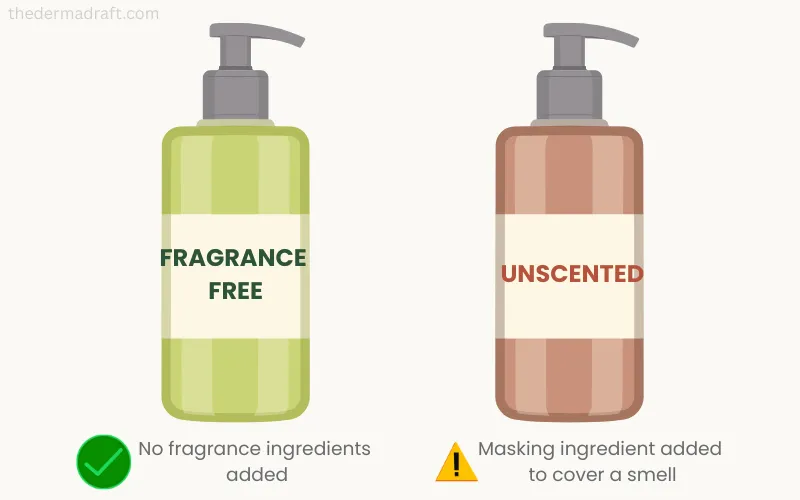
A brand added something, sometimes a masking chemical like a phthalate, to neutralize a smell, and that ingredient is still sitting on your skin.
If your skin is reactive, fragrance-free is the safer word to look for. Unscented can still carry the exact allergens fragrance-free is supposed to protect you from.
One brand I came across, Neude Skin, markets its scent as IFRA-certified and safe by extension. IFRA certification means the fragrance complies with IFRA Standards, which set science-based limits for the safe use of fragrance ingredients. It does not mean that no individual will ever experience a reaction. Those are two different promises, and it is an easy line to misread if you are not looking closely.
None of that changes if you buy anything afterward. I am not on commission, unlike a lot of the “best fragrance-free product” roundups ranking above this page.
Why Your Skin Reacts and Your Friend’s Doesn’t
Fragrance allergy is not rare, but it is not universal either. A 2020 review in Dermatologic Clinics puts general fragrance allergy in the population at somewhere between 0.7 and 2.6 percent.
People who get patch tested for a suspected skin problem show a positive fragrance reaction far more often, in some clinics as high as 1 in 10, per the same Dermatologic Clinics review.
The gap between those two numbers is the whole story. Fragrance sensitization builds over repeated exposure. Your skin can tolerate a fragranced lotion for three years and then, seemingly overnight, start reacting to that exact same bottle. That is not your imagination and it is not a coincidence. It is how sensitization works.
A large 2021 population study, the EDEN Fragrance Study, patch-tested more than 3,000 people across five European countries and confirmed that skin exposure to everyday scented products is directly tied to fragrance contact allergy, exactly the build-up pattern described above.
A damaged barrier speeds this up. If your cleanser is already stripping your skin, fragrance molecules get through more easily and your reaction risk climbs, even from a product you have used for years without a single issue. My guide on cleanser causing skin redness covers exactly why that stripping happens in the first place.
When Good Actives Get Blamed for Bad Fragrance
Fenty Skin launched with a strong, sensible ingredient list. Niacinamide, hyaluronic acid, glycerin, all genuinely useful actives for beginners, the kind I cover in my guide on niacinamide, hyaluronic acid, and retinol. It still ran into public pushback over one thing: fragrance.
People with sensitive skin posted about reacting to a formula they had been excited to try, even at a fragrance concentration under 1 percent. The actives were not the problem. The scent was, and it undid the trust the rest of the formula had earned.
That pattern is worth remembering. A well-built routine can get sabotaged by fragrance stacking, especially once a retinoid enters the mix. Fragrance on top of a retinol or retinaldehyde adds a second source of irritation right when your skin is already adjusting, and my guide on retinaldehyde vs retinol covers what that adjustment period actually looks like.
One good ingredient does not cancel out one bad decision sitting right next to it in the same bottle.
2026 Is the Year Your Ingredient List Gets Longer
Here is something almost nobody selling you a fragranced product has mentioned. Cosmetics rules around fragrance disclosure are changing, and the timing is not small print.
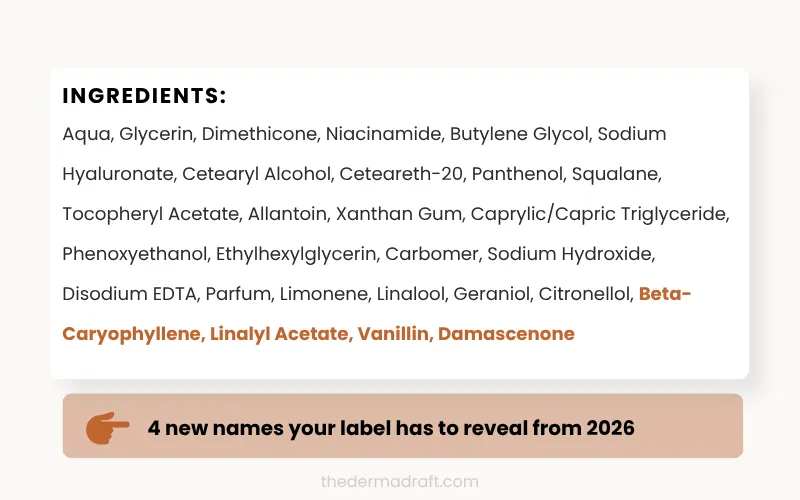
The EU expanded its official list of fragrance allergens that must be named on the label, growing it from 26 substances to roughly 80. New products have to comply by 31 July 2026, and anything already on shelves before that date can still be sold until 31 July 2028, under Commission Regulation (EU) 2023/1545.
Canada is moving even faster. Under Health Canada’s SOR/2024-63 update, it already requires 24 of those allergens on labels as of April this year, and expands to the full matching list on 1 August 2026, just weeks away.
The US is further behind. MoCRA (Modernization of Cosmetics Regulation Act) requires the FDA (Food and Drug Administration) to publish its own allergen disclosure list, and as of the most recent update, that rule still was not finalized. The UK, for now, is sticking with the old list of 26.
| Region | Current rule | What’s changing |
| European Union | 26 named allergens | Expands to roughly 80 by 31 July 2026 |
| Canada | 24 named allergens since 12 April 2026 | Expands to match the EU’s full list by 1 August 2026 |
| United States | No mandatory allergen list yet | FDA rule required under MoCRA, still pending |
| United Kingdom | 26 named allergens, unchanged | No confirmed date to adopt the EU update |
Practically, this means a longer, stranger-looking ingredient list on products you already own is coming. Nothing got worse. You are just finally being told what was already there.
How to Actually Test if Fragrance Is Your Problem
Before you write off every fragranced product you own, run a simple test.
For three days, use one fragranced product and nothing new alongside it. No other new actives, no other new cleansers. Watch for four things: redness within 5 minutes of applying, tightness or itching within 10 minutes, stinging when you layer moisturiser on top, and redness still visible after 20 minutes. It is a similar approach to the 3-day method I use for cleanser reactions.
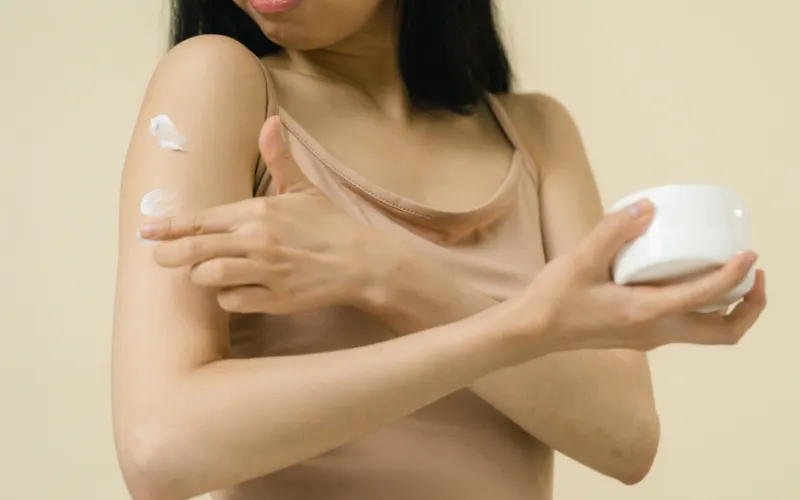
If you get a consistent reaction across all three days, fragrance in that product is a genuine trigger for you and switching to fragrance-free is worth it. If nothing happens, the fear is doing more work than your skin’s actual response.
Either way, you learn something real instead of guessing off a label or someone else’s video.
Frequently Asked Questions
Is fragrance in skincare actually bad for your skin?
Not automatically. Most people tolerate fragrance in skincare with no issue at all. It becomes a problem for people with sensitized or reactive skin. For the general population, fragrance allergy sits around 0.7 to 2.6 percent, not the majority some content implies.
What is the difference between fragrance-free and unscented skincare?
Fragrance-free means no fragrance ingredients were added at all. Unscented means a masking ingredient was added to cover up a smell, and that masking chemical is still on your skin. If you are reactive, fragrance-free is the safer word to look for.
Are essential oils safer than synthetic fragrance in skincare?
Not necessarily. Common allergens like limonene and linalool come from citrus and lavender oils, and they get more likely to irritate skin once they have oxidized after time in the bottle. Natural does not automatically mean gentler.
Does IFRA certification mean a fragrance will not cause a reaction?
No. IFRA certification means the amount used sits under an industry safety limit. It does not guarantee a sensitized person will not react, since that limit is set for the general population, not for your specific skin.
Why is my skincare ingredient list about to get longer?
The EU is expanding its mandatory fragrance allergen list from 26 substances to roughly 80, with new products required to comply by 31 July 2026. Brands that sell worldwide often update labels everywhere at once, so this may show up outside the EU too.
How do I know if fragrance is actually causing my irritation?
Use one fragranced product alone for three days with no other new products. Watch for redness within 5 minutes, tightness within 10, stinging under moisturiser, and redness still present after 20 minutes. Three consistent reactions point to fragrance as your trigger.
Can fragrance sensitivity develop after years of using the same product with no problem?
Yes. Sensitization builds with repeated exposure and can appear even in skin that tolerated a product for years. A damaged barrier speeds this up, since fragrance molecules penetrate more easily once your skin’s protection is compromised.
Should I avoid all fragrance if I have sensitive skin?
Not necessarily. Fragrance-free is the safer default for reactive or barrier-compromised skin, but plenty of people with mild sensitivity never react to fragrance at all. Test before you eliminate, rather than assuming the worst.
Can fragrance damage the skin barrier?
Fragrance itself does not automatically damage the skin barrier in healthy skin. The problem is repeated irritation or sensitization, especially in people already dealing with over-exfoliation, eczema, rosacea, or retinoid irritation. Once the barrier is compromised, fragrance molecules penetrate more easily and reactions become more likely.
The Bottom Line
Fragrance in skincare is not the villain half the internet makes it out to be, and it is not harmless either. The honest answer sits in the middle. Fine for most people, genuinely risky for sensitized or barrier-compromised skin, and about to be labeled more honestly than it has been in decades.
Test your own skin before you follow a blanket rule you saw online. Fragrance-free if you are reactive. Fine if you are not, at least until proven otherwise. Keep an eye on your ingredient list over the next two years. It is going to tell you more than it used to.
Related Articles
- Cleanser causing skin redness: why pH and surfactants might be the real reason behind reactive skin, and the 3-day test to confirm it
- Niacinamide, hyaluronic acid, and retinol: what these three actives actually do, and why fragrance-free versions matter most when you are introducing them
- Retinaldehyde vs retinol: the missing middle step in the vitamin A family, and why adding fragrance on top makes the adjustment period harder
Sources
- Commission Regulation (EU) 2023/1545 (2023): Amending Regulation (EC) No 1223/2009 as regards labelling of fragrance allergens in cosmetic products
- Dermatologic Clinics (2020): Reeder, Allergic Contact Dermatitis to Fragrances, general population prevalence and patch-test reaction rates
- Contact Dermatitis (2021): Skin exposure to scented products used in daily life and fragrance contact allergy in the European general population, the EDEN Fragrance Study
- Health Canada, Regulations Amending Certain Regulations Concerning the Disclosure of Cosmetic Ingredients (SOR/2024-63): fragrance allergen disclosure timeline for the Canadian market
About the Author
Hi, I’m Sidra.
I’m not a dermatologist or any kind of skincare pro, I’m just someone like you, who got sick of constantly switching up products and never having a clue what was really working. After years of trial and error, I decided to focus on one thing: consistency.
I test routines on myself, I track results in detail, and I write about what realistically shifts and what doesn’t. My aim is to dispel hype and discuss skin-care the way I would with a friend: practical, honest, and backed by patience instead of promises.
Skin type: Normal to dry skin with mild sensitivity
The information in this article is for educational purposes only and does not replace professional dermatological advice. If you have a specific skin condition or concern, please speak with a qualified healthcare provider.