

KEY TAKEAWAYS
- Red skin after every cleanser is a pH or barrier problem, not bad luck
- Healthy skin sits at pH 4.5 to 5.5. Most foaming cleansers push it to 9 or 10
- SLS and SLES strip your skin’s natural lipids and that causes the redness
- After washing, skin should feel neutral. Not squeaky, not tight
- Micellar water, oil cleansing, and cream cleansers work for reactive skin
- The 3-day test tells you if your cleanser is actually the trigger
- Redness that won’t clear between washes may be rosacea, not a product issue
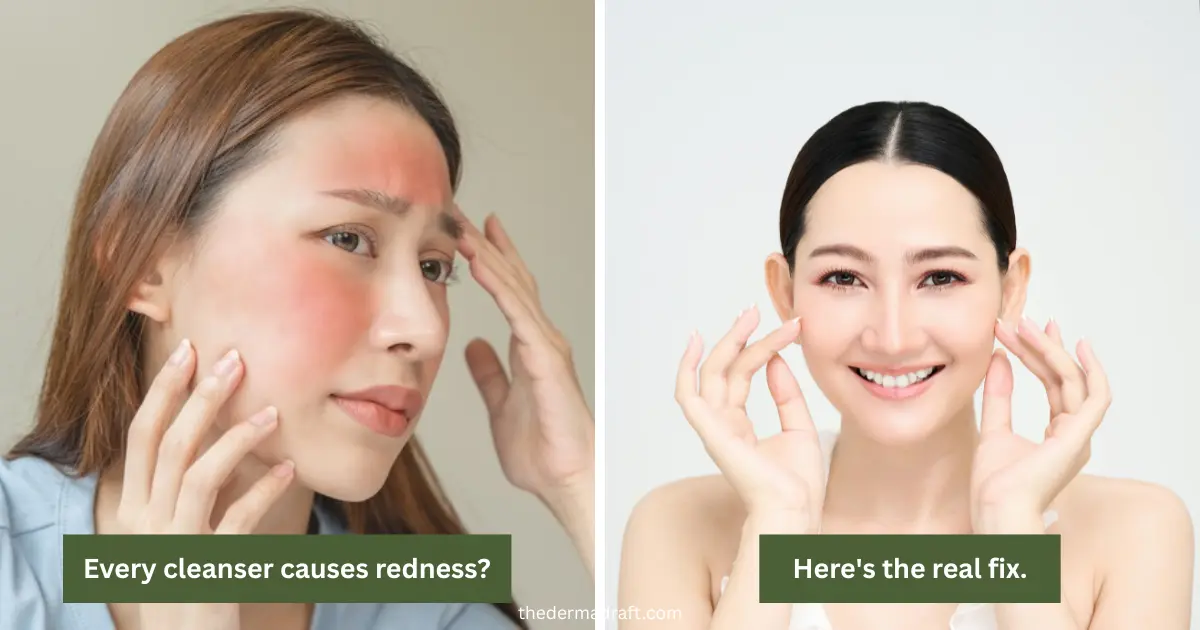
Why does cleanser cause skin redness?
Cleanser causing skin redness is almost always a pH or surfactant problem. Your skin’s natural pH sits at 4.5 to 5.5. When a cleanser raises that to pH 9 or 10, the barrier breaks down, moisture escapes, and blood vessels near the surface dilate. Harsh surfactants like SLS make it worse by stripping your skin’s natural lipids. The fix starts with understanding your skin’s chemistry, not buying a new cleanser.
If your skin turns red every time you wash your face you might be using the cleanser. Even if you’ve tried cleansers the problem might still be with your cleanser. Despite using different cleansers, if you are facing the same problem, then it might be your cleanser causing skin redness.
This article explains why your cleanser might be causing skin redness. It covers your skin’s pH, the ingredients in your cleanser, water temperature and tap water quality.
Cleanser Causing Skin Redness, It Starts With Your Skin’s pH
Your skin has a natural pH of 4.5 to 5.5. That mild acidity keeps your barrier healthy & strong and your protective microbiome balanced.
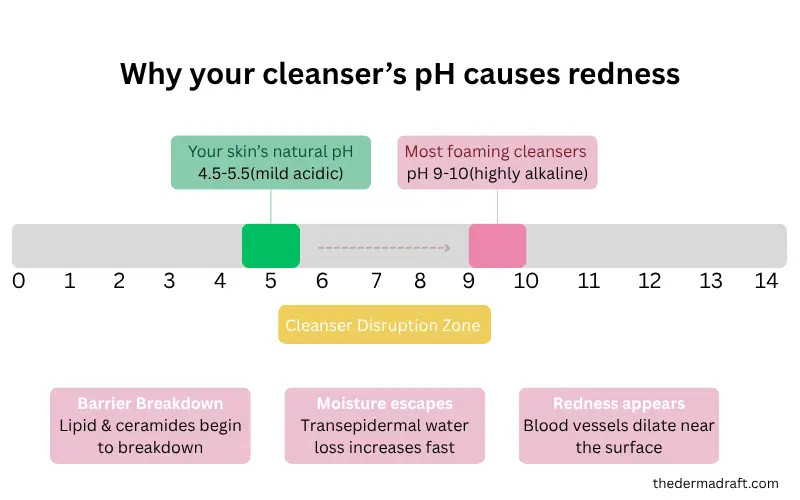
Dr. Zoe Diana Draelos, a board-certified dermatologist, has noted in published research that the skin’s acid mantle is central to barrier function and resistance to irritants. When pH shifts upward, the barrier starts to break down. This is further supported by Schmid-Wendtner and Korting (2006), who confirmed that the skin’s acidic pH plays a critical role in both permeability barrier formation and antimicrobial defence.
Most bar soaps have pH 9 to 10. Some foaming cleansers are not much better.
A 2002 study in the International Journal of Dermatology (Baranda et al.) confirmed that high-pH cleansers directly correlate with measurable irritation and dryness across all skin types. With twice-daily washing, that disruption adds up faster than most people realise.
When a high-pH cleanser strips the acid mantle, your skin’s protective lipids (ceramides, cholesterol, fatty acids) begin to break down. Moisture escapes. Blood vessels near the surface dilate. You see redness and feel tightness.
Does Hot Water Make Skin Red After Washing?
Yes and it’s one of the most overlooked triggers. Hot water dilates surface blood vessels and strips the same lipids as a harsh cleanser, before the product even touches your skin.
Use lukewarm water only, use your fingertips rather than a cloth, and pat dry without rubbing. These changes alone can cut redness noticeably, even before you switch your cleanser.
Hard Water and Skin Redness: The Hidden Trigger
If you live in any hard water area ( UK, Pakistan, parts of the US or Australia), your tap water contains elevated calcium and magnesium. These minerals mix with surfactants during washing and form a residue that deposits on skin, raises its surface pH, and causes redness.
If your skin reacts at home but not when you travel and you use the same cleanser elsewhere, the main cause can be hard water.
Rinsing with micellar water instead of tap water, or fitting a basic filtered showerhead, can make a visible difference without changing your cleanser at all.
What Is SLS and Why Does It Irritate Sensitive Skin?
Every foaming cleanser contains some surfactants. These are the molecules that do the actual cleaning. One end bonds to oil and debris. The other bonds to water. When you rinse, everything washes away.
The problem is that some surfactants don’t stop at dirt. They pull out your skin’s natural lipids at the same time, and those lipids are what hold the barrier together.
SLS (Sodium Lauryl Sulphate) is in the majority of foaming cleansers on the market.
Research published in Dermatologic Therapy (Ananthapadmanabhan et al., 2004) confirmed that SLS caused substantially greater barrier disruption than milder alternatives like cocamidopropyl betaine, and that difference appeared across all skin types, not just people with pre-existing sensitivity.
SLES (Sodium Laureth Sulphate) is a milder version but still a strong surfactant. A sulphate-free label means SLS and SLES are out. It doesn’t mean the formula is gentle. Check the full ingredient list, not the front of the bottle.
How to Spot SLS and SLES on a Cleanser Label
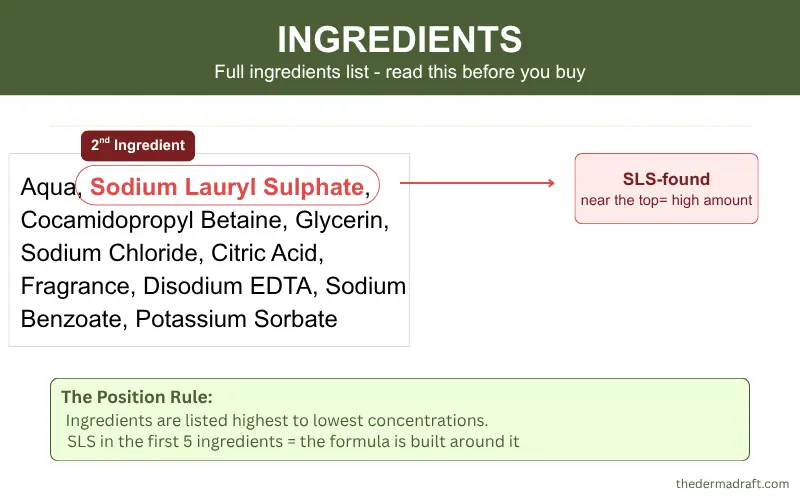
Ingredient lists run from highest to lowest concentration. If SLS appears in the first five ingredients, the formula is built around it. Scan every cleanser for these names:
- Sodium Lauryl Sulphate (or Sulfate)
- Sodium Laureth Sulphate (or Sulfate)
- Ammonium Lauryl Sulphate
- Ammonium Laureth Sulphate
- TEA-Lauryl Sulphate
SLS-Free Cleanser Alternatives for Sensitive Skin
Amino acid surfactants are the current standard for reactive skin. They clean effectively without pushing the skin’s pH out of its natural range.
The table below breaks down the main options.
| Surfactant Name | Irritation Level | Typically Found In |
| Sodium Lauryl Sulphate (SLS) | High | Most standard foaming cleansers |
| Sodium Laureth Sulphate (SLES) | Medium-High | Many drugstore gel cleansers |
| Cocamidopropyl Betaine | Low-Medium | Gentle and sensitive skin cleansers |
| Coco-Glucoside | Low | Natural and organic formulas |
| Sodium Cocoyl Glutamate | Low | Amino acid-based cleansers |
| Sodium Lauroyl Sarcosinate | Low-Medium | SLS-free gentle formulas |
What a Good Cleanser Should Feel Like After Washing
After washing with a cleanser that works for your skin, you should feel nothing unusual. Not squeaky. Not tight. Not warm. Just your face, normal.
The squeaky-clean feeling means your barrier was stripped.
The friction you feel is moisture loss and the skin contracting. That’s not cleanliness. Tightness sends the same signal. Lipids were removed alongside the dirt.
A cleanser that works leaves your skin feeling exactly the same as before you washed. No redness ten minutes later. No dryness by mid-morning. No stinging when moisturiser goes on.
If any of those happen consistently, the cleanser is doing more damage than cleaning, no matter what the label says.
Gentle Cleanser for Reactive Skin: Three Methods That Work
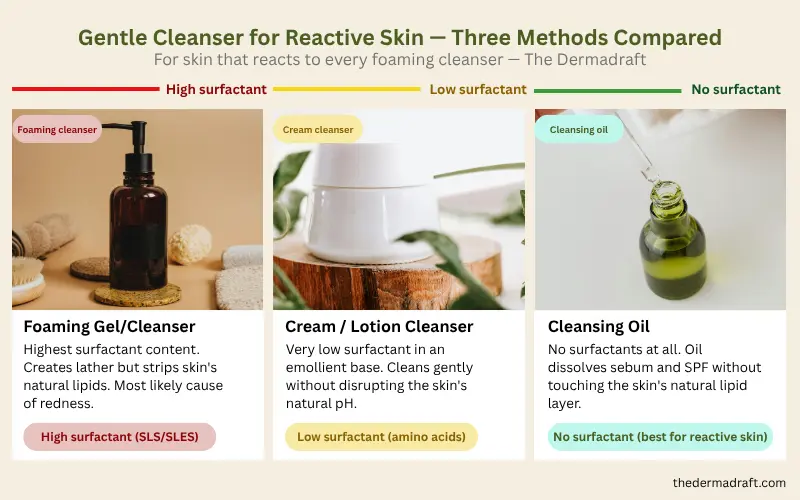
If your skin reacts to every surfactant-based cleanser, switching to a different formula might not be enough.
These three methods work when surfactants themselves are the root problem.
Micellar Water for Sensitive Skin: When It’s Enough
Micellar water uses tiny oil molecules to lift dirt and light makeup without surfactants or rinsing. It’s a low-irritation option for mornings without heavy SPF residue, or as a prep step before a gentler second cleanse.
The limitation is that it doesn’t fully remove heavy sunscreen or waterproof makeup on its own. Pair it with a very gentle cream cleanser for evenings. Sensitive skin cleanser must not be too harsh.
Oil Cleansing for Reactive Skin: Does It Actually Work?
Oil dissolves oil. A light facial oil (jojoba, squalane, or a purpose-made cleansing oil) massaged over dry skin lifts sebum and SPF without any surfactant contact. Rinse with lukewarm water.
For people stuck in a repeated cleanser redness cycle, oil cleansing is often what finally breaks it. There’s no surfactant making contact with the skin at all.
Cream Cleanser for Sensitized Skin: The Dermatologist Default
Cream cleansers use very low concentrations of mild surfactants in an emollient base. They clean gently, rarely push skin pH far enough to cause redness, and leave a thin layer of moisture behind.
If your skin barrier is already reactive, fragrance can become another source of irritation even in an otherwise gentle routine. Before assuming every scented product is harmful, read my guide on fragrance in skincare to understand when it’s perfectly fine and when it starts causing problems.
If you want to simplify while your skin resets, the only minimal skincare routine beginners actually need is to walk through how to build around three stable products with the right cleanser for a reactive starting point.
The 3-Day Cleanser Sensitivity Test
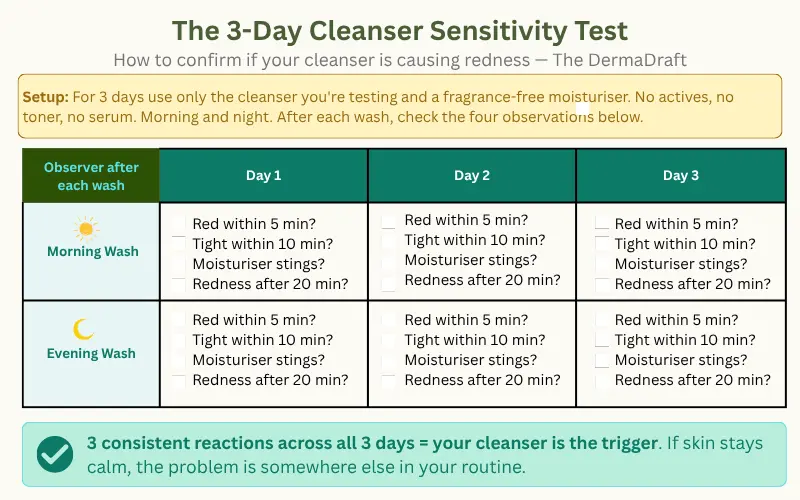
Before you assume permanent sensitivity, for three days, use only the cleanser you’re testing and a simple fragrance-free moisturiser. No actives, no toner, no serums, Morning and night.
After each cleanse, check four things:
- Redness visible within 5 minutes of rinsing?
- Tightness or dryness within 10 minutes?
- Moisturiser stings when applied?
- Redness still present after 20 minutes?
Three consistent reactions across all three days confirms the cleanser is your trigger.
If skin stays calm throughout, the problem might be something else in your routine.
The guide on why you’re still breaking out with a consistent skincare routine covers how to audit the rest of your product lineup for ingredients that quietly build up barrier damage across multiple products at once.
Rosacea, Sensitized Skin, or Just the Wrong Cleanser?
Not all facial redness after washing is a product reaction. Treating the wrong cause means months of no progress.
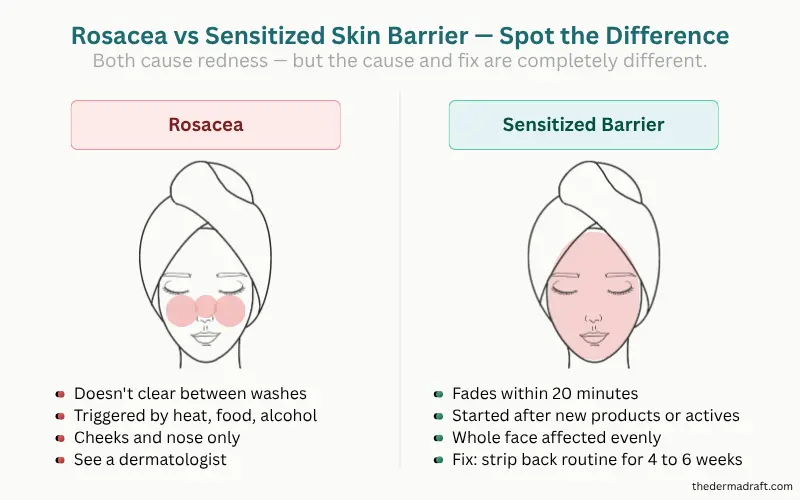
Rosacea is a chronic inflammatory condition. It causes persistent redness concentrated on the cheeks and nose, visible blood vessels, and flares triggered by heat, alcohol, or spicy food. This happens regardless of which cleanser you’re using.
Sensitized vs Sensitive Skin: What’s the Difference?
Sensitive skin is a characteristic you’re born with. Sensitized skin is damage that builds up over time, usually from over-cleansing with stripping formulas, overuse of actives like retinol or AHAs, or both at once.
The barrier thinned gradually until the skin started reacting to products it previously tolerated fine. It’s the most common root cause behind every cleanser irritating the skin. And it’s fixable, just slow.
Sensitized barrier signs: redness covers the whole face, not just cheeks and nose, it starts after you introduce new products or actives, fades within 20 minutes, and your skin recently stopped tolerating things it was fine with before.
The only fix is to rebuild your barrier. Strip back to cleanser, fragrance-free moisturiser, and SPF for at least 4 to 6 weeks. Avoid all actives. Your skin renews its outer layer roughly every 28 days, so expect one full cycle before seeing stable improvement.
When your skin is stable and you’re ready to reintroduce actives, the guide on niacinamide, hyaluronic acid, and retinol explains which one to start with and in what order.
Also The morning vs night skincare routine for beginners covers how to sequence those three products correctly so you’re not adding further disruption while your skin recovers.
Frequently Asked Questions
Why does a cleanser make my face red?
Your cleanser is likely disrupting your skin’s pH. Healthy skin sits at pH 4.5 to 5.5. Most foaming cleansers has pH 9 to 10. That shift breaks down the barrier and dilates blood vessels near the surface. Harsh surfactants like SLS strip your natural lipids at the same time. Switch to an amino acid-based or cream cleanser and confirm with the 3-day test.
Is it normal for skin to be red after washing?
A little redness that goes away in under 5 minutes is okay when you wash your skin with water.. If your skin stays red for more than 15 minutes or feels tight and stings that’s not normal. It means your skin barrier is irritated. If this keeps happening, something in your routine is hurting your skin.
Why does my face feel squeaky clean after washing?
Squeaky skin means the barrier was stripped. Healthy, clean skin feels neutral after washing. No friction, no tightness. That squeaky feeling comes from moisture and lipids being removed along with the dirt. It’s overstripping, not cleanliness. Switch to a gentler formula
Does cleanser pH cause skin redness?
Yes it does. If your cleanser has a pH of 9 to 10 it can hurt your skin’s protective layer, which has a pH of 4.5 to 5.5. This can make your skin red. Look for cleansers with a pH of 5 to 6. A 2002 study (Baranda et al., International Journal of Dermatology) confirmed this correlation across all skin types. Look for cleansers with a pH of 5 to 6.
What is SLS and why does it cause redness?
SLS (Sodium Lauryl Sulphate) is the surfactant in most foaming cleansers. It strips your skin’s natural lipids, the fats that hold the barrier together. Research (Ananthapadmanabhan et al., 2004) showed SLS caused significantly greater barrier disruption than milder alternatives, even across normal skin types.
What’s the best gentle cleanser for reactive skin?
Try a cream cleanser with amino acid surfactants or oil cleansing with jojoba or squalane. These options clean your skin without hurting it. Before buying a cleanser do a 3-day test to see if it’s really the cause of the problem.
How do I test if my cleanser is causing redness?
For 3 days, use only the cleanser and a fragrance-free moisturiser, nothing else. After each wash, check for redness within 5 minutes, tightness within 10, stinging on moisturiser application, and redness still present after 20 minutes. Three consistent reactions across all 3 days confirms the cleanser is the trigger.
Can hard water cause facial redness after cleansing?
Yes. Hard water minerals (calcium and magnesium) mix with surfactants to form a residue that deposits on skin and raises its pH. This is common in the UK, Pakistan, and parts of the US and Australia. Rinsing with micellar water instead of tap water can reduce this significantly without changing your cleanser.
Is post-cleanser redness rosacea or sensitized skin?
Rosacea causes persistent redness on the cheeks and nose that doesn’t fully clear, and it flares with heat, food, or alcohol. Sensitized barrier redness covers the whole face, starts after new products, and fades within 20 minutes. If the rosacea pattern fits consistently, see a dermatologist rather than switching products.
How long does it take a damaged skin barrier to repair?
With a simple routine (gentle cleanser, fragrance-free moisturiser, SPF), most people see improvement in 2 to 4 weeks. Skin renews every 28 days. If damage builds up over months of stripping cleansers or actives, allow 6 or more weeks of consistent simplicity before expecting stable results.
Bottom Line
Cleanser causing skin redness is almost always a chemistry problem, not a sensitivity you’re stuck with forever. Fix the pH, remove the harsh surfactant, and give the barrier time to rebuild. Most people find their skin stops reacting within a few weeks of consistent simplicity.
Related Articles
- Morning vs night skincare routine — why timing your cleanser and SPF matters for barrier recovery
- Skin purging vs breakout — how to tell if your skin is adjusting or reacting to a product
- Minimal skincare routine for beginners — three products to build around while your barrier resets
- Guide on Niacinamide, Hyaluronic acid & Retinol: Learn the Use & pros & cons of these three most talked ingredients
- Fragrance in skincare — when it’s completely fine, when it quietly damages your skin barrier, and how to tell which category your skin falls into
Sources
- Baranda, L. et al. (2002): Correlation between pH and irritant effect of cleansers marketed for dry skin. International Journal of Dermatology, 41(8), 494–499.
- Ananthapadmanabhan, K.P. et al. (2004): Cleansing without compromise: the impact of cleansers on the skin barrier and the technology of mild cleansing. Dermatologic Therapy, 17(S1), 16–25.
- Draelos, Z.D. (2018): The science behind skin care: Cleansers. Journal of Cosmetic Dermatology, 17(1), 8–14.
- Schmid-Wendtner, M.H. and Korting, H.C. (2006): The pH of the skin surface and its impact on the barrier function. Skin Pharmacology and Physiology, 19(6), 296–302.
About the Author
Hi, I’m Sidra.
I’m not a dermatologist or any kind of skincare pro, I’m just someone like you, who got sick of constantly switching up products and never having a clue what was really working. After years of trial and error, I decided to focus on one thing: consistency.
I test routines on myself, I track results in detail, and I write about what realistically shifts and what doesn’t. My aim is to dispel hype and discuss skin-care the way I would with a friend: practical, honest, and backed by patience instead of promises.
Skin type: Normal to dry skin with mild sensitivity
The information in this article is for educational purposes only and does not replace professional dermatological advice. If you have a specific skin condition or concern, please speak with a qualified healthcare provider.